

I can’t remember the exact age I was when I first read An Occurrence at Owl Creek Bridge, but I can still remember with perfect clarity the feeling that settled over me when I reached its final line. It wasn’t just the satisfaction that comes from a story well told, nor even the shock of the clever twist that the story is most famous for. It was something deeper, something that lingered long after the words had been put away, as if the story had not ended so much as it had opened a door I had not known was there. That door, once opened, never closed again.
It is a strange thing to say that a story can alter the course of a life, but I believe this one did for me. It wasn’t in any sudden or dramatic way, not in the sense that I rose from reading it with a pen in hand and a calling clearly defined, but in the quieter, more enduring sense that it planted something. A recognition that a story could do more than entertain, that it could press into the deeper places of the mind and reveal something about the nature of reality itself. It would take me nearly fifty years to take that recognition seriously enough to attempt such work on my own, but the seed was planted there, in that moment, and it never entirely stopped growing.
What continues to astonish me about Abrose Bierce’s work is not simply that he tells a compelling story within a relatively short span, but that he does so while operating on multiple levels at once, weaving together tension, perception, and philosophical inquiry in a way that feels effortless. When the story concludes, the reader is left not only with the memory of what has happened, but with a sense that something has been revealed, something difficult to articulate and impossible to ignore.
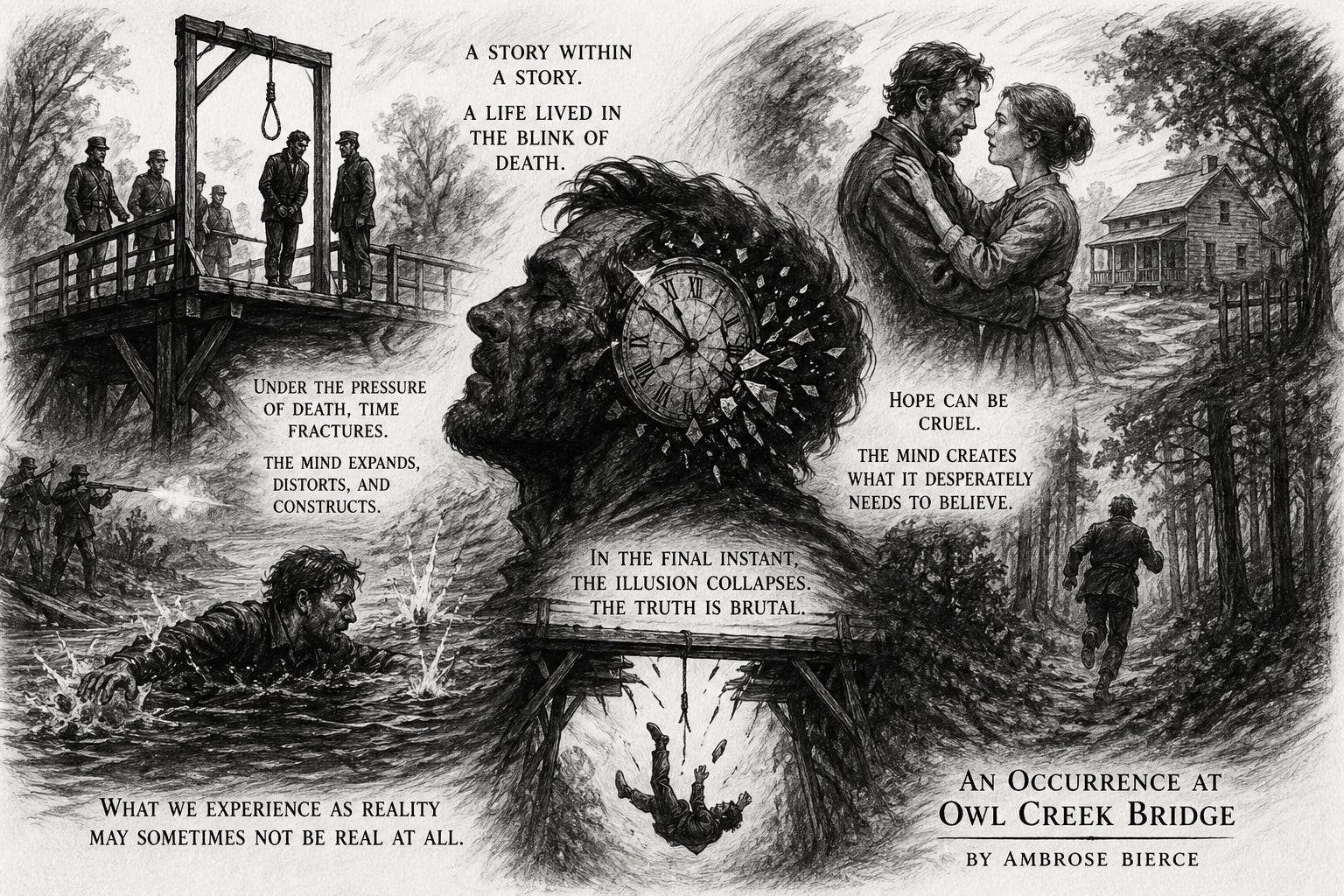
The premise itself is disarmingly simple. Peyton Farquhar, a Southern civilian during the Civil War, stands upon a bridge with a noose around his neck, moments away from execution at the hands of Union soldiers. The mechanics of the scene are described with an obsessed precision. The placement of the rope, the positioning of the soldiers, the slow and measured unfolding of the moment, Bierce gives us every detail, as though by anchoring us so firmly in the physical world he might prepare us for what is to come. And then the world shifts.
Farquhar falls, and in falling, he does not die. Instead, the rope breaks. He plunges into the water below, and what follows is a desperate, vivid escape. He swims beneath the surface as bullets tear through the water around him. He breaks free of the current, finds the shore, and runs through the forest with a clarity of perception so heightened that the world seems almost unbearably alive. Every leaf, every branch, every sensation is rendered with a sharpness that feels at once miraculous and unnatural, as though the world has been stripped of its dullness and revealed in some deeper, more essential form.
It is here, in this middle movement, that Bierce begins to do something far more brilliant than simply narrate an escape. He invites the reader into a reality that feels complete, coherent, and fully lived, even as something beneath it begins to feel slightly askew. The experience is too perfect, too ordered, too accommodating of Farquhar’s desperate need to survive. It is not that the reader immediately recognizes the illusion, but rather that the story carries within it a tension between what is being experienced and what can reasonably be believed.
And then, in the final movement, the illusion collapses.
Farquhar reaches home. He sees his wife. He moves toward her, toward safety, toward the restoration of everything that has been threatened. And in that moment, precisely at the point where hope reaches its fullest expression, Bierce ends it. The way he does it is not gentle. He doesn’t explain it. He does it with a single, brutal correction. Farquhar has not escaped. He has not run nor has he returned home. He has died on the bridge, and everything that has been experienced since the fall has occurred in the span of a final, collapsing instant of consciousness.
What Bierce accomplishes here is not merely a clever narrative trick. It is something far more profound. He compresses an entire lived experience of struggle, fear, hope, and imagined salvation, into the final flicker of a dying mind. In doing so, he forces the reader to confront a question that lingers long after the story ends: what, precisely, is the nature of reality when filtered through human consciousness?
Under the pressure of death, time does not simply slow, it fractures. What a man experiences as distance, effort, and duration is revealed to be something altogether different when measured against the objective passage of events. The mind, faced with annihilation, does not surrender quietly. It expands, distorts, and constructs, reaching outward to create a world in which escape is still possible, even if only for a moment. In that sense, Farquhar’s escape is both entirely false and, in another way, completely real. He lives it. He feels it. He believes it. And for that final instant, belief is enough to sustain it.
There is also, within this construction, a kind of cruelty that Bierce does not soften. Hope, in this story, is not a virtue in the traditional sense. It is not rewarded and it is not vindicated. Instead, it becomes the very mechanism through which the illusion is sustained. The reader is drawn into it alongside Farquhar, made to want his escape, to invest in it, to believe in it, only to have that belief stripped away in the same moment it is fulfilled. In this way, Bierce does not merely deceive the reader, he implicates them, revealing how easily the mind embraces a narrative that promises survival, even when that narrative cannot possibly be true.
And yet, for all its severity, the story does not feel dishonest. There is no sense that the reader has been cheated. The clues are there, embedded within the texture of the narrative, in the heightened perception, the dreamlike precision, the subtle dislocations that hint at something being constructed rather than experienced. Bierce does not hide the truth so much as he allows the reader to participate in overlooking it. The deception is not forced; it is chosen.
I find myself returning to this story again and again. Each reading reveals something slightly different, not because the story changes, but because I do. There is a depth within it that resists being fully exhausted, a sense that it is always operating just beyond the reach of complete understanding. It is, in that way, a reminder of what fiction at its highest level is capable of achieving.
For a writer, there is both inspiration and intimidation in encountering a work like this. It sets a standard that feels, at times, impossibly high. To compress such weight into so few words, to construct a narrative that functions simultaneously as story and as inquiry into the nature of perception itself, these are not small accomplishments. And yet, it is precisely this kind of work that calls others forward, that suggests there is something worth attempting, even if one never fully reaches the same heights.
Because what Bierce reveals, beneath the mechanics of plot and the brilliance of structure, is something more enduring. He reveals that the human mind, even in its final moment, refuses to accept the limits placed upon it. It reaches beyond them, constructs meaning where none may exist, and insists, if only for a second, that the story is not yet finished.
And perhaps that is the most disturbing truth of all, that what we experience as reality may sometimes not be real at all.