
The Little Red Calf
An Aged Cowboy in the Storm

I’ve been debating all week whether to post this story or not. I’ll give you a little background. First of all it’s long, over 16,000 words which makes it almost three times longer than my typical short story. A more talented writer would have probably been able to condence it while preserving the core of the story - I wasn’t able to do that. So that means the middle part of the story that gets into a storm scene could be too dense, I apologize if that is the case. But to my eye, that density is necessary. Secondly, the genesis of this story idea goes back almost twenty years to one of my first attempts at writing fiction, so let me explain.
About a month ago I started working on an essay for my Story and Meaning section here on Substack that focuses on the Old Man and Sea by Ernest Hemmingway. What I love most about that story is what it reveals about the nature of mankind, that our true character as a man or woman is most revealed by the things we do when nobody is watching. The way we act when there’s no camera, no witnesses, just ourselves and whatever task we’re focused on - that’s where we get to discover who we really are at the core.
While writing this essay, I remembered that years earlier, I had written a story inspired by The Old Man and the Sea. I tried to find it and couldn’t at first until I found a laptop that I was using back in 2007! I pulled the story up, and read it, and it was terrible! It was one of my first attempts at writing fiction. While the bones of the story and premise were sound, I had tried to cram into a few thousand words what needed alot more space to breath and unfold.
So, for the past month, I took that original story and began to work on it again which resulted in this story. While I like the finished product, the risk here given the length is that I didn’t do a good enough job compressing some of the scenes - my logic is that I needed that depth to bring out the core themes I’m trying to hit on.
So, having said all that, here you go! I hope you enjoy the story!
The Little Red Calf
By: Larry B. Litton Jr.
The tiny house sat low against the wind as though it had learned that crouching towards the earth would fare better than standing tall against something that rarely tired. It was built of rough-cut boards gone gray with salt and years, its roof sagged just enough to suggest that it had once been straight and proud before the long seasons bent it toward the ground. Beyond it, the land stretched flat and open toward the Gulf, a wide, quiet expanse of marsh grass and dark water channels that caught the light in broken strips. And farther still, though you could not always see it, the sea breathed in and out like a vast, sleeping beast, sending its wind inland in long, steady sighs.
Inside the house, the old man sat at a narrow wooden table with a tin cup resting between his hands. He had not yet taken a drink from it. The coffee had gone lukewarm, but he did not seem to mind. He sat as though time moved around him rather than through him, his shoulders slightly hunched, his head bowed not in weariness exactly but in a kind of quiet habit, like a man who had spent too many years riding against the wind and had never quite straightened again.
His name was Elias Rourke, though most folks along that stretch of coast had long since taken to calling him simply “Rourke” or, when they thought he was too far off to hear, “the old man.” There had been a time, not so many years ago, though it felt like another life entirely, when his name carried a weight with it. Men had spoken it with a kind of reverence, the way they spoke of a good horse or a strong mule, something you could rely on when the work turned hard and the weather worse. He had driven cattle through all the trails of Texas and beyond before the railroads had taken over. He had been the man the cattlemen called on first when a herd needed driving through dangerous country, he never failed to arrive on time and with the herd intact. That was no small feat in those days.
But time had a way of thinning a man out, not all at once but in quiet measures, the way water eats at the bank of a river. It first took the quickness from his hands, then the strength from his back, and finally the confidence others placed in him, which might have been the heaviest loss of all. Now, nobody calls on him for work anymore. Even for short runs to the rail station the cattlemen looked past him, toward younger men with straight backs and easy laughter.
Rourke did not blame them for it. There was no use in blaming the world for him getting old. Still, there were moments, quiet ones like this, when the wind pressed against the house and the boards gave a low, tired creak, that he felt something in his chest stir. It wasn’t anger or even regret exactly, but a kind of distant remembering, as though he were watching a man he once knew ride off across an open plain and could not quite recall when he had lost sight of him.
A soft knock came at the door, though it was more a courtesy than a necessity, for the latch had been broken for years.
“Come on in,” Rourke said, his voice low and even, as though it had no reason to rise.
The door opened and the boy stepped inside, bringing with him a breath of cool morning air and the faint smell of salt and wet grass. He was small for his age, though there was a quickness to him, a kind of restless energy that seemed always on the edge of spilling over. His name was Thomas, but Rourke had taken to calling him Tom, and the boy did not seem to mind.
“You’re up early,” the boy said, though he knew well enough that the old man was always up before the light had fully come.
“I’m always up early,” Rourke replied.
The boy smiled at that, as though it were part of some ongoing conversation between them that did not need to be spoken in full each time. He moved about the small room with an ease that suggested he had been there often, which he had. He set a small bundle of kindling near the stove and glanced toward the cup on the table.
“That coffee any good?” he asked.
“Not really,” Rourke said. “Tastes like roasted turds.”
The boy nodded, accepting this as sufficient.
For a moment they stood in silence, the wind moving softly along the walls, the light beginning to gather in the corners of the room. Then the boy stepped closer and leaned his elbows on the table, studying the old man’s hands.
They were large hands once, and still broad through the palm, but the skin had drawn tight across the knuckles and the veins stood out like small cords beneath the surface. There were scars there, too, pale and thin, some so old they seemed part of the hand itself.
“You ever get tired of it?” the boy asked.
“Tired of what?”
“All of it,” the boy said, though he did not specify what he meant.
Rourke considered this, his gaze drifting for a moment toward the narrow window where the light had begun to show more clearly.
“No,” he said at last. “I’m not tired. Just… slower, I reckon. I’ve still got some use in this old world.”
The boy smiled slightly.
“You’re not slow,” he said. “Not really.”
Rourke allowed himself the faintest hint of a smile, though it passed quickly.
“That’s kind of you to say,” he said.
Outside, a gust of wind pressed harder against the house, rattling the loose edge of a board along the far wall. The boy turned his head toward the sound.
“Storm’s coming,” he said.
“Maybe,” Rourke replied.
“A few in Galveston are saying it’ll be a big one.”
“They’re always saying that.”
But even as he spoke, his eyes moved again to the window, and there was something there now that had not been there before, not concern exactly, but recognition, as though the air itself carried a message he had learned long ago how to read.
The boy followed his gaze.
“You think they’re right?” he asked.
Rourke did not answer right away. He rose slowly from the chair, and crossed to the door. He opened it and stepped out onto the small porch, the boy close behind him.
The land lay quiet before them, the marsh grass bending in long, slow waves beneath the wind. The sky was a dull, heavy gray, though the sun had begun to press faintly against it, giving the clouds a kind of muted brightness. It was not yet the look of a storm, not fully, but there was something inside it, something waiting.
Rourke stood there for a long moment, breathing in the air, listening not just to the wind but to what lay within it.
“It’ll come,” he said finally.
The boy shifted his weight.
“Bad?”
Rourke nodded once.
“Bad enough.”
They stood together in silence, the wind moving past them toward the inland fields, carrying with it the faint, distant scent of the sea. After a while, the boy spoke again, his voice quieter now.
“I figure some folks around here may need help,” he said, “you’d help them, wouldn’t you?”
Rourke looked down at him, and for a moment there was something like surprise in his eyes.
“I suppose I would,” he said.
The boy nodded, satisfied, though he did not say why.
They turned back toward the house then, the morning fully upon them now. And yet there was a weight to it, a subtle shift in the air that neither of them spoke more of, as if the land itself were holding its breath.
Inside, the coffee still sat untouched on the table, gone colder now than before. Rourke picked it up at last and took a slow drink, his gaze drifting once more toward the window, where the gray sky stretched wide and unbroken toward the Gulf.
He did not know yet what the storm would ask of him. But he felt, in some quiet and certain way, that it would ask something.
**
The morning wore on without ever quite becoming day. The clouds came in low and thick, choking the light that spread itself across the marsh and the flats in a thin, colorless wash. From the porch, the land looked stretched and forlorn. The grasses bent low under the wind and did not rise fully again, and the narrow runs of water that crossed the marsh showed a dark and nervous surface. Far off, beyond the last ragged line of reeds and scrub, the Gulf could not be seen, but its presence lay over everything. It was in the taste of the air and in the strange heaviness pressing at the horizon, and in the long uneasy gusts that came inland as though carrying word of something large and gathering.
Tom remained on the porch beside the old man, one hand resting on the rail where the paint had long ago peeled away. He had grown quieter since Rourke had said the storm could be bad. The boy was at that age when fear and fascination still lived close together, and whatever was moving in from the water seemed to stir both in him at once. He kept looking eastward as if he might catch some first true sign of it, some dark wall or turning cloud that would make the danger plain and visible. But the weather had not yet declared itself so openly. It lay instead in suggestion and pressure, in a sky too low for morning and a wind that seemed to know a stronger blow wasn’t far behind.
Rourke stood with one hand braced against the porch post, his eyes moving over the flats with the habit of a man who had learned long ago to listen to the wind and to watch the clouds overhead. He had put on his old hat before stepping outside, and the brim trembled faintly when the stronger gusts struck it. The years had made him narrower through the middle and taken some flesh from his face, but there was still a hardness about him when he stood looking at the land, a kind of old alignment returning to his frame, as though the sight of weather and distance called back the shape of the man he had once been.
Tom glanced up at him. “You can feel it now,” he said.
Rourke nodded. “I felt it before. It’s just louder now.”
The boy looked out again. “It don’t look like much yet.”
“It don’t have to,” Rourke said. “These are but the birth pangs. She’s out there, gathering herself.”
There was no boasting in the words and no effort at mystery. He said them as plainly as a man might speak of fence wire or feed. Still, the boy listened closely, because Rourke’s plainest words often seemed to carry more weight than other men’s speeches.
The road that ran past the house was little more than a long strip of packed shell and dirt cut through the grass country, and it had been empty most of the morning. Now, from somewhere south, there came the slow clop of horses and the creak of leather. Tom turned first, then Rourke. Two riders emerged through the gray light, moving at an easy pace, their horses with heads low against the wind. They were old men themselves, though not so old as Rourke, and each wore the look of someone who had spent half a life in the saddle and the other half telling stories about it. One was broad through the chest with a beard gone yellow-white around the mouth, and the other was thin and long-faced, with the kind of eyes that seemed always narrowed by suspicion or amusement. They rode with the loose confidence of men passing through country they believed they knew better than everybody else.
As they neared the house, the broader one lifted a hand in mock salute. “Morning, Rourke.”
Rourke inclined his head. “Morning, Del.”
The other rider gave Tom a glance and then looked back at the old man. “You look nervous there Rourke,” the rider said. “Don’t tell me they got you worried about this storm too.”
Tom shifted slightly, already sensing the edge in the man’s voice, but Rourke did not move. The horses the men road were skittish, pawing nervously at the ground and they pulled their heads up and down.
“Your horses appear a bit worried,” Rourke said.
The broader man laughed. “The wind has ‘em riled a bit is all.”
“I see,” Rourke said. “You boys be careful.”
The two riders smiled at that, but there was little kindness in it. They had known Rourke in better years, and the trouble with men who had known a man in his strength was that some of them could not bear his decline without making a sport of it. It was easier, perhaps, to laugh at age than to admit they rode nearer to it themselves each season.
The thin one leaned in his saddle and looked at the house, then at the old man’s narrow shoulders. “How many years since you’ve been on a horse? Eight? Ten?”
Rourke rested both hands on the porch rail. “It’s been a while.”
“This weather’s gonna pass,” the man said with a laugh. “You’ll see.”
Tom’s face tightened. He looked toward Rourke, waiting perhaps for an answer sharper than the one he received.
“I hope you’re right,” Rourke said.
The broad man laughed again, though the sound was shorter this time, as if something in the old man’s calm did not give him as much pleasure as he had hoped. He tugged at his reins and shifted in the saddle. “Well, if the wind blows your roof off, we’ll come by and give you a hand.”
The two of them smiled at their own wit. Tom’s hands had curled into fists at his sides, and there was color in his cheeks now, but Rourke only stood watching them with that same level gaze, neither resentful nor submissive, as if the words fell against him and found no purchase.
“You boys keep an eye on the sky,” he said. “This one’s coming harder than you think.”
The thin rider snorted. “We’ve seen weather before, old man.”
“I know you have.”
There was nothing more to add. They rode on, their horses picking up the road again, the sound of hooves and tack moving north into the dimness. Tom watched them go with open dislike.
“I don’t like those men,” he said after a moment.
Rourke kept his eyes on the road until the riders were smaller shapes against the low country. “You don’t have to.”
“They got no right talking to you like that.”
Rourke looked at him then, and the lines in his face seemed deeper in that flat gray light. “Some men have bitter hearts. Best thing you can do is let them say their piece and ride on.”
Tom frowned. “That ain’t fair.”
Rourke turned back toward the marsh. “Fair ain’t got a thing to with it.”
The boy was quiet at that. The wind moved stronger through the grass, and from somewhere inland came the sharp uneasy cry of birds lifting all at once from a stand of reeds. The sound carried strangely, too loud in the damp air, then faded.
After a while, Tom said, “You think they’re wrong about you?”
Rourke did not answer at once. He seemed to listen first to the wind, or perhaps to some older and more private thing.
“I think,” he said, “that a man doesn’t stay what he was. That’s just the way of it.”
Tom considered that with the seriousness he brought to all things Rourke said. He nodded once, as though storing it away.
A figure appeared down the road from the opposite direction, not on horseback but in a small wagon drawn by a bay mare that moved with nervous quickness. The wagon came faster than was usual for that road, and even at a distance there was something urgent in the way it leaned and rattled over the uneven ground. The woman holding the reins sat forward on the bench, her hat tied tightly under her chin, her dress pressed close to her by the wind. Tom saw her first and pointed.
“Someone’s coming.”
Rourke had already seen. He straightened slightly and stepped down from the porch as the wagon approached. The mare tossed her head once, foam at the bit, and the woman brought her up hard before the house. For a moment she did not speak. She seemed to be gathering breath and purpose together.
It was Mrs. Evelyn Mercer, who kept a spread a few miles down nearer the bayou country. She was not old, though weather and worry had put early lines around her eyes. Her husband had been dead near three years now, taken by a fever that moved through the coast settlements one summer and carried off enough men to leave more than one place half-run by widows and boys. Since then, she had managed the land herself with help where she could find it, and people had learned not to mistake her quiet for softness.
She climbed down from the wagon without waiting for assistance, though Tom moved at once to steady the mare. The woman looked from the boy to Rourke, and whatever she had rehearsed on the ride over seemed for a moment to falter under the pressure of what she feared.
“Mr. Rourke,” she said.
“Morning, Mrs. Mercer.”
“I’m sorry to come without sending word.”
“That’s all right.”
She glanced toward the south, and Rourke saw in her face the thing she had likely been trying not to show all morning. It was not panic, not yet, but the nearness of it. A person can carry fear a long way before it spills, and often the dignity lies in how long they manage to hold it.
“You believe this storm is going to hit hard?” she said.
Rourke looked past her toward the road, then to the sky. “I think it might.”
She nodded as if she had known he would say it yet still needed to hear it aloud. “The others keep telling me it may turn. Or weaken. Or blow itself out over the water.”
“It may do any number of things,” he said. “But I wouldn’t wager cattle or a house on it.”
The woman pressed her lips together. Tom stood by the mare with one hand on the bridle, listening with the grave stillness of a much older person.
“I’ve got near forty head on my south pasture,” she said. “Maybe a little over. It’s the lowest ground I hold, and if the bayou swells and the tide pushes in behind it, they’ll be trapped there.”
Rourke nodded once. He knew the pasture she meant. A broad, rich stretch in good seasons, but lying bad for flood.
“I need them moved to the north rise,” she said. “About twenty miles to get them out of the flood plain. Maybe a little less by the straight cut, though the straight cut will be mud if the rain starts before you’re across.”
Tom’s eyes widened slightly. Twenty miles with forty head in weather like this was no small ask, and he looked at Rourke as though waiting for the moment when the old man would tell her the truth of it.
Mrs. Mercer did not wait. The words seemed to come faster now, as if once begun they could not be held back. “Del Harmon helps me tend to ‘em and when I asked him to move ‘em, he just laughed at me and said I was being foolish. He said this storm wouldn’t be much of anything and if it did get bad the cattle couldn’t be driven on account they’d go crazy in the storm.”
At the mention of Del, Tom’s mouth set in a hard line. Rourke said nothing.
The woman looked directly at him. “I know what people say, Mr. Rourke. I know your age and I know this is bad work even in fair weather. I would not ask it if I had some other choice. But those cattle are about the last thing of value I can rightly call mine. If the storm drowns them where they stand, I do not know what comes after.”
The wind moved the hem of her dress and tugged loose a strand of hair at her temple. She did not smooth it back. Fear had stripped away the smaller vanities of composure. She stood there on the packed road with the whole of her worry visible in her eyes, and there was a kind of courage even in that.
Rourke looked out over the marsh and then back at her. “You got no other hands over there to help?”
“No sir.”
Tom had left the mare now and come close to the porch steps. He did not speak, but his face held a fierce intentness, as the world had narrowed to this exchange and would be changed by what the old man said next.
Rourke asked, “How long before the low pasture starts taking water?”
Mrs. Mercer turned and looked eastward. “The bayou is already at the top of the bank. If that storm brings any kind of surge, it’ll be three feet under by midnight and by morning it’ll be ten feet under.”
He nodded slowly. The sky had darkened another degree while they spoke. Not dramatically, but enough that the whole country looked flatter and more forsaken. The wind had shifted too, carrying now a wetness from the Gulf that had not been there earlier.
“I can do it,” he said.
The woman stared at him, not with relief exactly, but with the strained attention of someone who fears hope almost as much as despair. “Can you really?”
“I can certainly try,” he said. “But we got to get moving within the hour.”
Tom drew in a breath he had not seemed aware of holding.
Mrs. Mercer stepped nearer. “I can pay you. Not much, but a fair price.”
Rourke shook his head slightly, as if money were not the first measure entering his mind. “You can pay me if I get them there.”
“You got someone to help you?” she asked, glancing over at Tom.
“No,” he said. “Just me.”
At that, the old man glanced toward Tom, and for the first time that morning there was something near warmth in his eyes. “The boy’s not riding the herd in weather like this.”
Tom looked as if he might object, but something in Rourke’s expression warned him to hold his tongue for now.
Rourke went on. “I’ll be there within the hour. I need to get ready here first then me and the boy will come start rounding up the cattle. A scattered herd in weather like this turns into ten separate troubles before a man can blink.”
Mrs. Mercer nodded quickly. “Thank you.”
“And you’d best lay-up whatever else you can. Board your windows if they ain’t boarded. Draw water. Tie down anything the wind can carry. This one may come ashore meaner than folks think.”
Something in the certainty of his tone seemed to strike her more deeply than the words themselves. She lowered her head for a moment, then lifted it again with a grateful smile.
He gave a small motion with his hand, dismissing gratitude not out of coldness but because it felt premature. The work was still only an idea, and the land had a way of humbling ideas when weather rolled in.
Mrs. Mercer climbed back into the wagon. The mare was more restless now, stamping once and turning an ear toward the east. Before taking up the reins, the woman looked down at Rourke again, and whatever doubt she may once have harbored about asking him had given way to something else. Not certainty, but necessity joined to trust, which is the stronger bond in hard times.
“I’ll see you shortly,” she said.
Rourke nodded. “I’ll be there.”
She drove off southeastward, the wagon rattling down the road and growing smaller in the gray spread of morning. Tom watched until she was nearly lost to sight.
Then he turned to Rourke. “You’re really going.”
“Yes.”
“With weather like this?”
Rourke looked out toward the hidden Gulf, where the whole horizon now seemed pressed under one heavy hand. “Especially with weather like this.”
Tom said nothing for a moment. The wind moved around them and through the grass and under the porch roof with a hollow sound.
Finally he asked, “Why’d she come to you?”
Rourke rested a hand on the porch post. “She has nobody else to turn to.”
Tom shook his head. “No. I think there’s more to it than that.”
The old man stood quiet a long moment before answering. “Sometimes when trouble gets close enough, people stop caring so much for what’s said about a man. They start looking instead for what they believe he might still be.”
Tom took this in with a kind of solemn pride, as if the words belonged partly to him too because he had believed it all along.
**
Rourke spent the hour after Mrs. Mercer left in a kind of deliberate silence. He moved through the house gathering what he would need with the experience of a man long practiced in measuring necessity. There was no wasted motion in him, no fretful reconsidering, no standing still with his hands on his hips while the mind chased itself in circles. He took down the old rifle from above the door and broke it open to inspect the chamber before closing it again with the same care a man might use in folding a letter. He wrapped a few cartridges in a rag and placed them in the pocket of his coat. From a shelf he pulled a small canvas sack and filled it with hard bread, a strip of dried beef, and two apples gone a little soft at the skin but still sound enough to eat. He corked a tin flask and then another, and when he had done these things, he set them all upon the table and looked at them not with satisfaction but with simple acknowledgment, as if to say that whatever else the day might require would have to wait.
Tom followed him from place to place, trying at first to be useful and then, sensing something grave and inward in the old man’s quiet, settling into the more serious work of watching. The boy had that look upon him that comes over the young when they understand that events are beginning to move beyond the safety of talk and planning and into the harder world of action. He had ceased asking needless questions. When Rourke handed him the saddle blanket to fold, he folded it neatly. When he was told to fetch the bridle oilskin from the peg by the door, he brought the right one without fumbling. The gravity of the weather had rendered him fully alert.
Outside the window the sky continued to lower. There were no distinct storm towers yet, no great theatrics of the heavens, but rather a broad and terrible thickening from one end of the horizon to the other, as though the world were being slowly roofed over with darkened iron. The air had grown heavier too, so that each breath seemed to carry a burden. More than once Rourke paused by the door and looked southward toward the unseen Gulf, and each time he returned with less doubt and more certainty in his face.
At last, he drew on his coat and took up the rifle. “We’re going,” he said.
Tom was at the door before the words had fully settled in the room.
They saddled Rourke’s horse beneath a sky that had gone almost green-gray above the far marsh. The animal felt the weather as plainly as the men did. He tossed his head and shifted under the girth and rolled one eye toward the horizon. Rourke laid a hand along the horse’s neck and stood a moment in the wind, saying nothing. Tom held the stirrup leather and watched the old man with an expression caught somewhere between pride and worry.
“You don’t have to bring the rifle, do you?” the boy asked.
Rourke slid the canvas sack behind the saddle and tied it down firmly. “Hope I don’t need it.”
“What’s it for?”
“Just in case.”
Tom nodded, though he looked none too pleased with the answer. The notion of cattle had one shape in his mind and the notion of the storm another, but the old man had already begun to see how all living things, once pressed hard enough, lost the boundaries people liked to place around them. A frightened horse could kill as surely as a desperate wolf. A swollen bayou could drown a herd as quickly as open sea. Weather had a way of stripping the security off things and leaving only force behind.
Rourke mounted with the slow precision that age had taught him, and when he was settled, he looked down at the boy. “You coming on your own horse?”
Tom’s face brightened slightly. “Yessir.”
“You ride close and you mind what you’re told.”
“I will.”
The boy hurried off and returned with his small sorrel, a wiry animal more willing than elegant, and in a few minutes, they were on the road south and east toward the Mercer place, the wind pressing steadily in their face as though urging them to turn around while there was still time.
The country through which they rode looked altered already. The bayou channels that crossed the lower ground had risen into the reeds and spilled over banks where, that morning, damp mud had still shown bare. In the distance the marsh glimmered in wide patches where water had spread thin across the flats, turning the earth into a broken mirror beneath the leaden sky. Flocks of birds moved inland in hurried uneven shapes, and they passed a stand of live oaks where the cattle egrets that usually picked among the roots had vanished entirely. The whole world seemed to have become intent upon departure.
Tom rode beside Rourke for a while in silence before he said, “It looks worse than before.”
“It is worse.”
“You think the tide’s coming in already?”
Rourke looked toward a narrow cut where dark water pushed upstream in a way the boy had never seen. “It is. Faster than I like.”
Tom followed his gaze and swallowed. “Then why ain’t everyone moving?”
The old man considered that. “Some folks don’t believe a thing till it’s got hold of them. Others believe it and still can’t bring themselves to act. Men are slow, stupid creatures when they’re scared.”
Tom frowned, expecting fear to be a simpler matter than that. But there was no simple shape to it. Rourke had seen enough years to know that fear could make one man flee, another freeze, and a third laugh at danger until it swallowed him whole.
When they came over the final rise before Mercer’s place, they saw at once that the woman had not spent the intervening hour idle. She had loaded the wagon with crates and bedding. The pasture beyond the buildings was alive with cattle massed uneasily against the far fence, their bodies turning and pressing in a wave as if the whole herd felt the storm in its bones and could not settle.
Mrs. Mercer came from the yard before Rourke had fully dismounted.
“I’m glad you didn’t change your mind,” she said.
Rourke handed Tom the reins and looked toward the pasture. “How long they been moving like that?”
“An hour or more. They won’t hold still. The calves keep bawling and setting off the cows.”
He studied the sky, then the low country behind the south field. Beyond the fence line, where the land dipped toward the bayou, water shone where there should have been only grass.
“It’s started in already,” he said.
Mrs. Mercer followed his gaze, and something in her face tightened. “I saw it myself. That patch was dry this morning.”
Rourke nodded. “You were right to ask for help.”
He walked the yard then with the woman and Tom beside him, taking in the state of things with the same plain attention he had given his rifle and food sack. He asked short questions and received short answers. There were forty head of cattle, ten of them were calves. The north rise lay twenty miles off as measured by road, a little less by the rough cut inland, though the rough cut crossed low ground that would be treacherous once the rain came in earnest. The trail was a mix of flat grassland and woodlands. Rourke noticed one of the calves, a little red one with a white streak on his face, had a bit of a limp.
“Can you move all forty?” Mrs. Mercer asked.
Rourke stood a moment with his hat brim low over his eyes, studying the cattle. “I’ll give it my best. Some of the calves may struggle.” He nodded towards the little red calf.
She seemed to know this already, but hearing it spoken pained her all the same. “The coyotes had a go at him last week.”
Rourke nodded.
Together they moved to the pasture gate. The cattle smelled of wet hide and rising panic. Their bodies crowded shoulder to shoulder, eyes wide, ears flicking, tails switching as the wind worried them from every side. The ten calves, still lank in the knees and uncertain in their movement, pressed near the older cows and sent up their thin anxious bawling into the thickening air. Rourke stood leaning on the top rail and watched them until patterns emerged from what at first had seemed only confusion.
“I’ll cut from the east side,” he said. “Tom, you lead them out the gate and towards that trail heading north. Once they’re out the gate you head back home with your folks.”
Tom began at once to protest. “Let me ride with you.”
Rourke did not raise his voice. “You go home like I told you.”
The boy’s face flushed, but he bit down on whatever further objection had been rising in him. Mrs. Mercer glanced at him with sympathy and then back at Rourke, who had already gone on to other matters.
“You,” he said to her, “get that wagon loaded and outta here within the hour. Water, blankets, what food you can carry, and whatever papers or valuables matter. Once I push out you don’t wait on us to return. You head to the rise by road, and you keep going north.”
She stared at him. “And if the storm passes us by?”
“It won’t.”
“What if you’re back before dusk?”
“I won’t be.”
There was no harshness in the answer, only truth. The woman seemed to understand this from his tone better than she would have from any explanation. She looked toward the house, then toward the fields beyond it, and one could see in her eyes all the attachments a person forms to a place and how quickly those attachments become a noose when danger draws near.
“You think it’s that bad.”
Rourke looked to the bayou where the tidewater had spread another yard while they talked. “I think if you stay to find out, you may not get another chance to leave.”
Something passed across her face then, a hurt not of pride but of parting. To abandon one’s own place before the wind had even torn a board loose must have felt to her like surrender. Yet deep beneath that hurt there was sense, and she nodded once, sharply, as though forcing the decision cleanly into place.
The rounding of the herd took longer than Rourke liked. The cattle were too restless, Tom was too quick to overpress them, and the wind kept shifting at odd angles that made the animals wheel unexpectedly. But at last, the forty were gathered into a narrower body near the outer gate, with the ten calves woven among them near their mothers. The cows with calves kept turning their heads to count by scent and sound, and twice a young one broke from the herd and had to be turned back by Rourke who took to his horse like he’d never stopped riding.
By then the first rain had begun, not yet a downpour but a fine slanting fall that darkened hats and shoulders and raised the smell of wet earth. Out over the low country the sky had become almost black in places, and under that darkness the distant water shone like lead.
Tom came up beside Rourke as the old man checked the rifle in its saddle sheath and tightened the rope on his food bag. “You really aiming to do this by yourself?”
Rourke looked at him. There was rain caught in the boy’s eyelashes and worry plain in his face. “You make sure your folks listen to you. Ya’ll get to high ground. Hear me?”
Tom glanced toward the cattle, then back to the old man. “I don’t want to leave you.”
“I know.”
The boy said nothing more. There are moments when love offers itself first in defiance and then, finding no way through, falls quietly into obedience. This was one of those moments.
Mrs. Mercer came to them, her dress already speckled dark by rain. “The wagon’s almost ready.”
“Don’t wait if you don’t need to,” Rourke said. “Go as soon as you can.”
She looked beyond him toward the rough track north where the herd would soon move. “Will you bring them all back to me?”
He settled into the saddle before answering. “I’ll bring what can be brought.”
The words were not meant cruelly, but in them there was the hard limit of all such undertakings, and both woman and boy heard it.
Rourke turned his horse toward the rear of the herd and started pushing them through the open gate and out into the open field beyond. The herd hesitated in one dense uneasy cluster, their hooves churning the wet earth, their nostrils open wide to the storm scent. Then, under the pressure of horse and voice, they began at last to flow through the gate and out upon the track northward, not in smooth order but in a rough jostling line that held together by instinct and fear.
The rain strengthened. It struck now with a steadier rhythm, and the wind drove it almost sideways across the flats. Before riding after the herd, Rourke turned once more toward the yard where Tom and Mrs. Mercer stood close together beneath the darkening sky.
“Leave now,” he called to them. “Don’t wait on me. Head north and keep going.”
The woman raised a hand in acknowledgment. Tom did not wave. He stood with both fists clenched at his sides, rain on his face, watching the old man as though by the force of looking he might somehow remain near him.
Then Rourke touched his heels to his horse and rode after the cattle into the deepening weather. Ahead of him the forty head moved like a dark broken current across the flooding country, the calves stumbling to keep pace among them. Beyond them the trail bent north into a land already losing its shape beneath rain and shadow. To the east the bayous were filling fast, their waters creeping outward in silence more terrible than noise. And above all of it the storm clouds gathered themselves with a majesty so immense and indifferent that the works of men: houses, fences, wagons, even the small determined figures on horseback, seemed for a moment no more lasting than castles made of sand on a beach.
**
The cattle did not take to the trail so much as they resisted leaving the place they knew, and for the first mile Rourke drove them harder than he would have liked, establishing his control and pressing them forward with his voice and motion until the herd began to string itself into something resembling direction. The wind had risen steadily and shifted out of the east now since he left the Mercer place, and now it moved across the low country with a force that kept the trees bent as if in prayer. The rain came in waves of long horizontal lines that stung the face and blurred the distance ahead. The sky had lowered further, the gray deepening towards black and the clouds roiled and swirled, and the light had taken on that strange quality that comes before a storm has fully declared itself. The cattle felt it in ways men could not fully understand. They moved with their heads high and their nostrils wide, their bodies pressing too close together one moment and breaking apart the next, as though each animal sensed danger but could not agree on the direction from which it would come.
Rourke rode along the flank, his old horse working beneath him with a steadiness that belied the animal’s unease. He kept his eyes moving constantly, not only over the herd but beyond it, reading the ground ahead, the low places where water had already begun to gather, the narrow ridges where footing might still hold, the lines of brush and timber that could either shelter or trap depending on how the weather turned. The land would quickly transform from a tranquil flatland bordered by bayous into a maze of raging gullies as the surge and rain increased. The top layer of earth had begun to soften under the steady rain and the top layer loosened into a slick and treacherous skin that shifted under boot and hoof alike. Twice already he had seen the red calf stumble and go down, its thin legs folding awkwardly beneath it before scrambling back up into the press of bodies, bawling sharply until it found its mother again.
“Easy now,” he said aloud, though whether to the cattle or to himself he spoke was not entirely clear. His voice carried thinly in the wind, but the rhythm of it seemed to settle something, if only for a moment. “Keep your ahead about ya little one.”
The herd angled toward a stretch of slightly higher ground where the grass grew shorter, and the soil held firmer beneath it. Rourke guided them that way with small, deliberate movements, turning one lead cow at a time rather than forcing the whole at once. It was slower work, but it kept the panic from taking hold, and panic was the one thing that could break a drive entirely before it had truly begun. He had seen it happen before, long years ago, when a sudden thunderstorm on the plains had turned a thousand head into a single wild force that ran itself blind and broke apart across miles of country. That had been a different time, when his hands had been quicker and his seat in the saddle stronger, when he could ride hard for hours without feeling the cost of it settle into his bones afterward. Now, even in this first mile, he could feel the strain beginning to gather in his lower back and along his thighs, a dull and insistent reminder that the body keeps its own account of years whether the mind wishes it or not.
He shifted in the saddle and let out a slow breath. “You ain’t what you used to be,” he said quietly, reminding himself of a fact long known but not yet fully accepted. He said it plainly, like a man noting the weather or the lay of the land. Still, there was something beneath them, something like a reckoning that had waited a long while for recognition.
Ahead, the ground dipped toward a narrow marsh crossing where the water had already begun to creep across the trail in thin, widening fingers. What had been firm enough footing earlier in the day had softened now into a dark, uncertain stretch that reflected the dim sky above it. Rourke brought the herd down to a slower pace, circling wide to keep them from bunching too tightly as they approached the crossing. The rising tide started to carve out a deepening channel that ran through the marsh. The cattle balked at the water, their hooves testing the edge and pulling back, their bodies pressing sideways into one another in confusion.
“Come on now,” he called, riding up along the lead. “It ain’t deep. You’ve walked worse than this.”
The words were habit as much as instruction, but the tone mattered. He had learned long ago that cattle listened to the tone of a man’s voice, the steadiness or uncertainty in his voice carrying more weight than the meaning of the words themselves. He nudged his horse forward into the water, letting the animal pick its footing carefully, and after a moment one of the older cows followed, then another. The calves hesitated longer, their smaller frames trembling as they stepped into the cold and shifting ground, but the pull of the herd drew them on.
Halfway through the crossing, the red calf slipped and went down hard, its front legs folding beneath it as the mud gave way and it began to slide down towards the rushing gully. It let out a sharp, high cry that cut through the wind, and the cows nearest it turned suddenly, their own unease rising into something sharper. The herd began to bunch again, pressing toward the narrow center of the crossing where footing was worst.
Rourke moved without thinking, angling his horse toward the struggling calf. He swung down from the saddle, his boots sinking at once into the soft ground, and waded through knee-high water toward the animal. The cold came up through the leather and into his legs, and for a moment he felt the old quickness fail him, the movement slower than it would have been once, his balance less certain as the mud shifted beneath him.
“Come on now,” he said, reaching for the calf’s shoulder and pushing against it while lifting with his other arm. The animal struggled, its legs kicking weakly against the muck, its body slick with water and fear. “Come on. I got ya red.”
He braced himself and heaved again, feeling the strain pull through his back in a sharp line of pain that made him grit his teeth. For an instant, something like doubt flickered through him, quick and unwelcome. You ain’t strong enough for this anymore. You were a fool to think you were. The thought came unbidden and just as quickly he set against it, not with denial but with a kind of stubborn refusal to let it take hold.
“Today I am strong enough,” he muttered, the words low and nearly lost to the wind.
With one more effort, the calf found its footing and scrambled upright, stumbling forward into the press of the herd where its mother caught it at once, nudging it along with urgent insistence. Rourke stood a moment in the water, his breath heavier now, the ache in his back settling into something that would not leave him quickly. He placed a hand against his thigh and felt the tremor there, slight but unmistakable.
“So that’s how it’s going to be,” he said to himself. There was no anger in it, only a quiet acknowledgment. The body would have its say, and he would have to answer it as best he could.
He climbed back into the saddle with more care than he would have liked, the motion slower, deliberate, and once he was seated, he took a moment to steady himself before turning again to the herd. They had crossed now and begun to spread slightly on the firmer ground beyond, their movement less frantic but still uneasy, as though the storm had reached inside them and would not let go.
The rain came harder then, the drops thickening into a steady fall that blurred the edges of the land and turned the distance into a shifting gray veil. The wind rose with it, no longer a steady push but a series of stronger gusts that came in uneven intervals, rattling through the grass and bending the scattered brush until the earth itself was trying to lay down against the force of it.
Rourke rode on, keeping the herd moving northward, his eyes narrowing against the rain. “You’ve seen worse than this,” he said, though whether he meant himself or the cattle was not clear. “Or maybe you haven’t. Maybe this is the one that takes the measure of you.”
The words carried him back for a moment to another drive, years ago, when the sky had opened over the plains and the lightning had come down so close it seemed to split the air itself. He had been younger then, full of that quiet confidence that comes from having succeeded often enough to believe failure belongs to other men. He had ridden through that storm with a kind of fierce joy, feeling himself equal to whatever the land might demand. He could remember the strength in his hands on the reins, the way his horse had answered him without hesitation, the sense that he and the world were engaged in something like a contest and that he would not be found wanting.
“That man’s gone,” he said softly. “This one here is all that remains.”
The herd moved ahead of him in a rough and shifting line, the calves still struggling to keep pace, their smaller legs working harder with each mile. Red lagged again, his limp more pronounced now as the ground grew heavier underfoot. Rourke watched him for a moment, calculating without quite admitting he was doing so.
“C’mon Red,” he said under his breath. “It ain’t gonna be easy but you can make it.”
The land began to rise slightly as they pushed farther inland, the marsh giving way to firmer ground broken by low stands of timber and narrow ridges of higher soil. It should have made the going easier, but the rain had turned the paths between those rises into slick channels where water ran thin and fast, cutting through the earth and carrying it away in small, steady streams. The cattle slipped more often now, their hooves finding uncertain purchase, and each stumble sent a ripple of unease through the herd that threatened to build into something worse.
Rourke felt the fatigue settling deeper into him, not as a sudden exhaustion but as a steady accumulation, each small effort adding to the last until the whole of it began to weigh on him. His shoulders ached, his hands stiffened on the reins, and there were moments when the wind would press not just against his body but through it, as though trying to wear him down from the inside.
He leaned slightly forward in the saddle and spoke again, his voice quieter now. “You don’t stop,” he said. “You just keep them moving.”
The words were less instruction than promise, and in speaking them he felt something settle in him, a kind of old resolve that had not entirely left, only waited for a reason to return. The storm was no longer something approaching. It was here now, in the ground beneath him and the wind around him and the strain in his own body. And whatever it would take from him before it was done, it would not take him untried.
Ahead, the trail bent northward into a darker stretch of country where the trees stood closer together and the land dipped again beyond them. Rourke looked at that line of shadow and then back at the herd, judging distance, time, and the strength he still carried.
“All right,” he said. “Let’s see what you’ve got.”
And he rode on into it, the cattle moving before him in a long uneasy current, the rain falling harder with each passing minute, and the wind rising still, as storm had only begun to speak.
**
By dusk, the storm had fully declared itself. The world had ceased to resemble the one Rourke had entered only hours earlier. What had begun as a leaden sky and a hardening rain had thickened into something so complete that it no longer felt as though the weather had simply worsened, but as though the whole order of things had cascaded toward violence. The cattle moved through a darkness broken only by lightning, and the light no longer belonged to day at all, but came in shattered bursts that revealed the land in stark and terrible fragments. Between those white ruptures the world collapsed again into shadow, and it was in those shadowed intervals, more than anywhere else, that fear did its work.
The sound of the storm had changed too. Earlier it had been the language of bad weather, rain falling hard, wind moving over the flats, the low uneasy complaints of cattle who felt more than they understood. But now the sound had become something else entirely, layered and immense. Thunder did not roll gently from some far-off distance. It cracked open directly overhead and then spread across the low country in long, shaking concussions that struck the earth itself and travelled up through hoof and bone. Each report came like God’s judgment, sudden and violent, and in the seconds that followed even the cattle seemed to forget how to move, their bodies caught between instinct and terror.
Rourke rode within that sound as a man rides inside a war he cannot leave. He had lost the horizon some time ago. The trail itself had become little more than memory and guesswork, and the land around him now existed only in glimpses, a flooded hollow here, a broken line of reeds there, the dark humped backs of cattle moving through water that had risen far beyond what the low country should have held. He could not see far enough ahead to trust what lay in front of him, and he could not look long behind without feeling as though whatever was there had already been swallowed up by the storm. The flooding surge chased them northward, gaining ground on them.
The herd had broken once more under a crash of thunder so sharp it had seemed to split the very air. It happened all at once. A white blaze of lightning tore downward in the distance, and the cattle answered it with panic. They surged outward in several directions at once, some pressing left into a shallow flood basin, others turning blindly toward a stand of timber, calves bawling high and thin among the deeper cries of the cows. Whatever shape Rourke had managed to preserve in the herd through the last hour was gone in a heartbeat.
“No,” he said aloud, though the word was too small for what had just happened.
He rode hard along the nearest edge, pushing one knot of animals back toward the others, turning them by sound and pressure more than sight. His horse labored beneath him, frightened but keenly aware of what moved around them. The animal’s ears stayed high and forward, then flicked at every blast of thunder, at every bright, violent flash that made the world leap out in sudden detail and vanish again just as quickly. Rourke felt the horse’s muscles harden under him with each concussive report, felt the creature’s restraint like a second will working beside his own.
The water had risen to the point that every low place was suspect. Some stretches that looked shallow enough under lightning proved deeper when crossed, and more than once horse and rider plunged suddenly into water that climbed higher than expected, the horse lunging through with a force that nearly unseated him. Other places held only a skin of flood over mud so soft and greedy it tried to keep anything that stepped into it. The cattle knew none of this in any useful way. They only knew that the night had turned strange and loud and bright and blind, and that the ground they trusted had begun to shift under them. And still, Rourke had not lost a single one.
Rourke turned one group of three cows and two calves away from a cut where the water had begun to move fast enough to take a smaller animal clean off its feet. Another lightning flash showed him a pair of steers standing broadside in confusion, their bodies blocking one another while water swirled around their knees. He shouted, rode into them, pushed them apart, got them moving again, all of it done in seconds before darkness dropped over the scene once more and he had to rely on the splash and churn of their retreat.
Then he heard the cry.
It was higher and thinner than the others, and though all the calves had been crying off and on through the storm, this one struck him differently, perhaps because he had heard it before in nearly the same shape, perhaps because his mind had already begun to mark it as separate from the rest. He turned at once toward the sound and waited for the next lightning flash to show him what the dark would not allow him to see.
When it came, he saw the red calf.
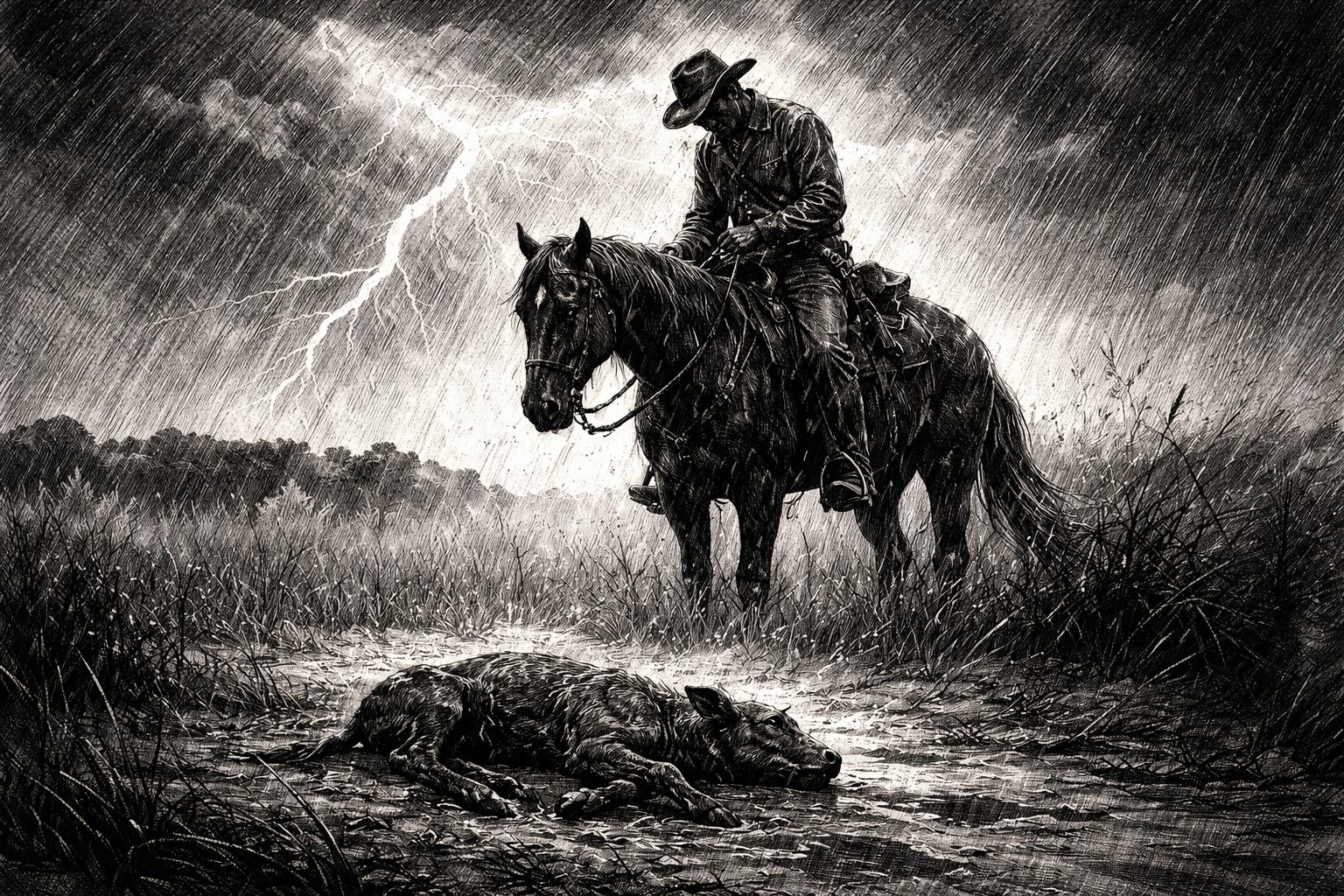
The little animal had fallen again, though this time not in some shallow patch of mud but near the edge of a flooded drainage where the water had begun cutting through the land with real force. Its forelegs were splayed badly beneath it, its body half twisted as it fought to right itself, and every effort only brought it nearer to the slipping edge where the current moved darker and faster than the flood around it. The white blaze on its face shone for an instant in the lightning and then was gone again.
“You poor thing,” Rourke said, though the words carried no irritation.
He rode toward it immediately, the horse plunging through knee-deep water, the splash of its passage swallowed almost at once by another crash of thunder so violent that for a moment he felt it in his teeth. The cattle nearest the calf had already drawn away from it, their own fear making them unwilling to remain near anything that had stumbled. A mother cow bawled once from farther off, but she did not return.
Rourke swung down from the saddle and went to one knee at once. He nearly fell over, the weariness stripping every muscle of energy. The ground there was treacherous, a mix of slick earth and loose wash, and the flood pulled against his boots with a steady sideways strength that made every step a test of will. He forced himself upright and waded to the calf, feeling the rain strike his shoulders and hat in hard, steady blows. Another lightning burst broke open the dark and for a second, he saw everything too clearly: the calf’s terrified eyes, the hard line of water just below it, the trembling weeds bent downstream, the whole terrible geometry of how close he was to being taken.
“Easy now,” he said, reaching down. “I’ve got you.”
The calf kicked as he got his arms beneath him, not from strength but from fright, and he drew it up against him with more effort than such a small body ought to require. It was not weight alone that cost him. It was the mud pulling at his legs, the water pressing at his shins, the exhaustion already laid into his back and shoulders from the long afternoon and now this black, drenched night. He straightened with the calf held close and felt pain move sharply along his spine like something drawn with a knife.
For one brief instant he thought, not in language exactly but in a bare and unsheltered way: this is too much.
Then thunder broke almost overhead, so near that the calf gave a convulsive jerk in his arms, and the thought left him as quickly as it had come. Then the calf looked at him and licked his face.
“You don’t get to die tonight,” he said to the animal, his voice low and grim. “Not while I’m still standing.”
He turned and slogged back the way he had come, each step uncertain, his boots sucking at the mud, his balance shifting with the flood. He could not see where to place his feet except when lightning came, and when it did the brightness was so fierce and unnatural that it made everything look false for that instant, the water like molten tin, the cattle like carved dark figures, the grass flattened and shivering beneath the rain.
He set the calf down near a slight rise no wider than a wagon bed, where a few cows had found enough footing to stand without being driven backward. The calf’s legs buckled once, then held. Its chest worked hard and fast, its ears slicked back, its sides shuddering with breath. Rourke kept one hand against its shoulder until he was sure it had found itself again. In the next white flare of lightning, he saw the little animal turn its head toward him, not in any meaningful way a man could name, but with a kind of bewildered dependence that gave him pause.
“Stay up now, Red,” he said. “I can’t keep fetchin’ you all night.”
The calf gave a thin, rattled bawl and edged closer to the body of a nearby cow, though not so close that Rourke lost sight of Him.
He remounted with difficulty, the stirrup harder to find than before, his wet hands slower, his body less willing. Once in the saddle, he sat a moment and listened. He could no longer count on sight alone. The storm had made the world too fractured for that. So, he listened for the herd: the churn of hooves in floodwater, the heavier breathing of frightened animals, the repeated cries of calves and the deeper answering calls of the cows trying to hold some thread of order between them.
And beneath those sounds, or just beyond them, there was something else.
He heard it first as a different rhythm in the darkness, not the wild and panicked movement of cattle but something more measured, more deliberate. It came and went in the rain, almost nothing, a soft splash here, a pause there, then silence. He turned his head toward it and waited. Lightning opened the night once more, and this time he saw them clearly enough.
Red wolves.
Not one, but several, spaced wide and low at the outer edge of the herd, their bodies half hidden by grass and water and dark, but distinct in that brief white glare. Their coats were made darker by the rain, though there was still enough of the rusty wash in them to set them apart from coyotes or gray wolves. Lean-muscled, long-legged, they moved with a patience the storm did not disturb. They had no quarrel with the thunder. They had no fear of the dark. The weather had not disoriented them. It had come on their side.
When the lightning died, they vanished again, but their presence remained, sharp and undeniable.
Rourke knew their kind. He knew them well. They were not the great northern wolves of story and legend, but something quicker, craftier, made for marsh and brush and low country. They did not need to challenge a whole herd to take what they wanted. They only needed one calf to lag. One animal to break wrong. One moment when the storm made confusion enough.
His eyes went at once toward Red. The calf still stood, wavering slightly, but alive and upright.
“That’s what you’re after,” he said into the storm, though whether to the wolves or to fate itself he did not know.
The wolves began to work the edges now, never rushing, never showing themselves fully except when lightning caught them. They swam easily through the low spots when the water deepened. One would appear in a white burst to the left, another farther back, another not moving at all except for the terrible calm of its stance. Their patience was worse than aggression. They were not driven by rage or fear, but by the simple and ancient confidence that something out here would weaken enough to become theirs.
The cattle sensed them. The outer edge of the herd tightened and shifted inward, several cows bunching hard enough to jostle the calves among them. The danger was plain: if fear of the wolves drove them too fast, they would scatter again, and if they scattered in this rising water, the storm itself would do the wolves’ work.
Rourke rode the edge and kept them moving, turning them away from the deeper cuts, turning them inward whenever panic began to outrun the herd’s need to stay together. It was no longer driving in any proper sense. It was salvaging. Saving pieces from being claimed by dark, water, or fear.
The thunder came again, so violent and immediate that his horse flinched sideways beneath him. A blast of lightning struck somewhere not far off, close enough that for an instant the smell of burned air reached him through rain and flood and cattle. Several animals bawled and surged. One of the calves broke left, another right. Red stumbled but did not fall.
“Stay with ’em,” Rourke said. “Stay with ’em, Red.”
The little red thing with the white blaze was no longer just one calf among many. It had become his talisman against the darkness of old age.
The wolves drew nearer.
He saw one in a lightning flare no more than thirty yards off, chest-deep in grass and water, head low, eyes fixed not on him but on the outer calves. Another stood farther back on a slight rise, still as carved wood. A third moved like a shadow between the flashes, never fully seen but felt in the movement of the cattle nearest it.
Rourke drew the rifle from its sheath and held it across his saddle. He did not raise it yet. He had no wish to spend a cartridge on a half-seen shape in weather that turned all aim uncertain. But the feel of the wood and metal in his hands steadied something in him.
“Come get some,” he said.
The storm answered with another crack of thunder so great it seemed the sky itself had split down the middle.
The herd lurched forward again, and he let the rifle rest back in the crook of his arm as he rode after them. The water was higher now. The dark was thicker. The wolves were circling. And ahead of him, barely visible except when lightning lifted the world into white ruin, moved Red, limping, stumbling, but somehow still keeping pace.
Rourke narrowed his eyes against the rain and settled deeper into the saddle.
“That’s right,” he said. “You keep moving, and I’ll keep coming.”
Then he rode on with the cattle into the full black throat of the storm, the thunder shaking the land, the lightning striking all around, the wolves running the edges of their fear, and the little red calf still alive within the broken current of the herd.
**
Sometime after midnight, the night had grown so thick and unnatural that time itself no longer held meaning. All of reality at that time and place condensed into the depths of the storm. Yet Rourke rode on, unsure as to if he could save the herd yet he cannot bring himself to abandon them. The darkness had deepened past ordinary night and into something more complete, a blackness broken only by the terrible white violence of lightning that opened the world in brief, pitiless flashes before sealing it shut again. The thunder continued to roar, and the wind sustained it’s fury and the rain struck with the hard, relentless force of thrown gravel. The floodwaters had risen so far across the low country that the distinction between trail and marsh and bayou had been nearly erased.
But Rourke had still not lost a single head.
That fact he carried more as a burden than as an accomplishment. He no longer thought in terms of success. It was simply the measure by which he refused to let the storm have him. Every cow still moving before him, every calf still crying somewhere in the blackness, every dark humped shape not yet taken by water or fear or wolves, had become part of a count he held in the back of his mind like a prayer spoken without words. There were forty of them. Ten of them were calves, and Red still carried on with them. And so long as that remained true, he remained undefeated against the storm.
But the cost of that belief had begun to show itself in him. His body had long since crossed from weariness into something deeper, and far more dangerous. His shoulders ached with a weight that no longer felt like pain exactly, but like the hard settling of iron into muscle. His hands had gone stiff on the reins, his fingers no longer closed as quickly as they should, and there were moments now when he felt a strange looseness in his seat, as if the cord between will and body had begun to fray. More than once, after a long burst of thunder or the sudden blind blaze of lightning too close overhead, his vision had narrowed for a second or two until all the world seemed to tilt and drain away, and only the discipline of long habit kept him from slipping sideways from the saddle into the floodwater below.
He knew this. He did not try to lie to himself about it.
“You’re hangin’ by a thread,” he said aloud once, though the words vanished as soon as they left his mouth, taken by rain and thunder alike. There was no self-pity in the admission. It was spoken the same way he might have marked a cut in the fence or a rise in the tide. It was simply the truth.
And yet he rode on.
The herd still moved in broken formation ahead of him, no longer a proper drive but a salvaged thing held together by fear, pressure, and what little instinct remained to them under such assault. The cattle had learned the shape of terror by now. Each crack of thunder sent a shudder through them, each burst of lightning made them wheel and bunch and strain, and only the constant labor of turning them inward, keeping them pointed toward whatever ground still held, preserved them from fully breaking apart. Twice in the last hour a few steers had bolted toward darker water and had to be pressed back. Once, two cows had stumbled and nearly gone under in a cut hidden beneath the flood until Rourke forced them out by sheer persistence of horse and voice. The calves, weakened by cold and long effort, cried more often now, and their cries had changed too, grown thinner and more frantic, as if even they had begun to understand the size of what moved against them.
Among those cries were those that came from Red.
The little calf had become impossible for him not to watch. His limp had worsened as the night deepened, and where once he had stumbled only at the harder crossings, now he faltered every few yards, recovering himself with a determination so disproportionate to his smallness that Rourke could not help but notice. In each white flash of lightning, he found himself searching for that patch of red hide and the narrow blaze of white down his face, and when he found it, some part of him settled, however briefly. Red had ceased to be merely one calf among many, he had become a kind of witness. A thing still alive in the night that ought by all reason to have already been taken.
The wolves understood this too.
They had drawn closer in the last hour, no longer content to work the distant edge of the darkness. Now they moved nearer the herd whenever thunder and confusion gave them cover, slipping in low through the flooded grass and vanishing again before Rourke might have taken a proper shot, their bodies lean and sure in the storm, their confidence born not of brute size but of patience and opportunity. Red wolves. Marsh wolves. Small by northern measure, but quick and cruel in the way of things that live by finding weakness. Their reddish coats flashed black and rust under the lightning, their eyes momentary sparks at the edge of sight. They were not frightened by the weather. If anything, they seemed to belong to it.
Rourke had seen one come too near not long before. The animal had broken from a stand of reeds no more than twenty yards from the outer edge of the herd, angling in low toward one of the smaller calves before a lightning strike caught it in full profile. Rourke had the rifle up before the darkness could close, fired almost by instinct, and the shot had cracked strange and small beneath the thunder. He had not heard the wolf cry, but in the next lightning flash he saw the body twisting in the water, one hind leg kicking uselessly before it disappeared into the flooded grass. A second wolf had shown itself later, bolder or more desperate, and he had shot that one too, not clean through the head as he might once have done in better light and with steadier hands, but through the shoulder, enough to drop it and send the others back into the blackness for a time.
He had not felt triumph in either shot. Only delay. They were still there, he could feel them.
The herd angled through a stretch of higher ground now, or what would have passed for higher ground in that ruined country, a broad ridge no more than a foot or two above the drowned marsh on either side. It was enough to let the cattle move with less swimming and more stumbling, enough to buy time. On both sides of the ridge the flood had deepened into dark channels that reflected nothing, and the grass beyond them lay flattened in long, shining sweeps. The rain had not lessened. It came without pause, rattling on hide and water and hat brim, turning every surface slick and every breath cold.
Red lagged again.
Rourke saw him fall behind the herd, head bobbing, legs uncertain, struggling to keep pace with a cow that could no longer slow for him without being pressed aside by the others. The calf’s cries had gone hoarse now, reduced to a desperate rasping bawl that scarcely carried beyond a few yards, and when lightning came it showed the animal’s narrow ribs and shaking knees and the way its white blaze shone like a mark placed there by some hand intent on making it visible even in darkness.
Rourke guided his horse nearer and rode along its flank for a while, as close as he could without trampling it in the herd’s disorder.
“C’mom Red,” he said. “Just stay up a bit longer.”
The calf turned his head once at the sound of his voice. In the lightning-bright instant that followed, Rourke saw his eyes, wide and dark and shining with fear, and there was in them something so nakedly helpless that it struck him harder than any sight the storm had yet shown him. Not because the animal understood him, nor because it possessed any special quality beyond the fact of being alive and afraid, but because he seemed to look at him as though help were a thing that might still come.
That look stayed with him. And because it stayed, he found himself riding closer still, turning the herd in whatever way he could so that Red remained within the safer press of the cows.
Another crash of thunder split open overhead, so violent and immediate that his horse flinched beneath him and the cattle surged all at once in confused alarm. The ridge narrowed ahead, the floodwaters on either side dark and moving, and for several moments the herd lost all semblance of shape, cattle pressing shoulder to shoulder, then fanning out again, some nearly going down, calves crying, cows answering, the whole miserable body of them trying to outrun a terror that had no edge and no center.
Rourke rode hard along the outside, turning one cow, then another, forcing them away from the drop into the deeper water. He shouted until his own voice sounded strange in his ears, a ragged and half-spent thing. Lightning struck somewhere near enough ahead that for an instant the whole ridge leapt into white brilliance, every blade of grass and every streaming contour of water etched with impossible sharpness. Then came the thunder, no delay at all, just a shattering concussion that seemed to split the night open directly over their heads.
The herd broke.
It happened so quickly and so completely that afterward he would remember it in fragments only: a wall of dark bodies surging left, another knot turning right, a pair of steers plunging forward into the flood, calves driven out from between the cows, the horse wrenching beneath him as if trying to flee from the sound itself. He fought for control and nearly lost it. For a breath or two there was no herd, only panic in every direction.
And in that one terrible break of order, Red was left alone.
The calf had been thrown clear of the cows by the sudden surge and now stood isolated at the edge of the ridge, limping in a stunned half-circle, bawling once, thin and desperate, into a darkness that answered at once.
The wolves came in without hesitation. Rourke saw them in the lightning.
Three red wolves broke from the grass and water like pieces of the storm itself, low and fast and perfectly certain. One hit first at the calf’s shoulder, another at its hindquarters, the third circling for the throat as the little animal went down under the force of them. It all happened in less than a second. Red cried out once, a high, tearing sound so full of fear and surprise that it seemed to pass straight through the storm and into him, and then the sound was cut short under the violence of what followed.
“No!”
The word tore out of him with a force that shocked even him, and he drove his horse toward them, rifle already up, one-handed, barely seeing through the rain and lightning and the heaving panic of the herd around him. He fired once. The shot struck one wolf broadside and threw it clear in a rolling splash of water and mud. He worked the lever and fired again. Another wolf twisted away, hit but not stopped, vanishing into the dark. The third animal held half a second longer than it should have, jaws deep at Red’s throat, before the horse came crashing so near that it broke away and fled in a long, low streak through the flood.
Rourke was off the saddle before the horse had fully stopped.
He nearly fell when he landed, his legs too slow now, his body too spent, and he caught himself with one hand in the mud before reaching the calf. Red lay on its side in the flooded grass, his white blaze matted dark, his body kicking once in a small and useless motion that ended almost before it had begun. Blood was everywhere now, washed thin already by rain and flood, running bright and then vanishing into the black water around them. The calf’s eyes still moved, wide and bewildered, and when Rourke dropped beside him and gathered his head into his lap, he felt that gaze fix on him once more.
“I’m here,” he said, though the words came broken now. “I’m here, little one. I got you.”
There are wounds the world gives that no hand can close, and this was one of them. The calf’s breath rattled thinly, once, then again, and then no more. Red’s small body shuddered in his arms and went still, and the rain kept falling, and the thunder kept breaking overhead, and the herd kept bawling and moving in the dark as if nothing in creation had changed.
Something in Rourke gave way. Not outwardly at first. He did not cry out. He did not curse the storm or the wolves or God. He only bent over the little ruined body in his lap and held it while the water moved around his knees and the rain ran down his face in hard, cold streams. His hat had been knocked back, and the lightning showed him the white blaze now dimmed under blood and water, and the narrow red sides that had worked so hard all night just to keep pace with the larger world trying to leave him behind.
“You fought,” he said quietly. “Lord, you fought.”
He bowed his head lower over the calf and felt, to his own surprise and then not to his surprise at all, the grief of losing the calf. He held Red in his arms as the storm raged all around him and he stroked his neck gently. But beneath that grief and mixed with it until the two could not be fully separated, there was something else. He mourned then for the man he no longer was and could never be again. He realized the unbearable, humiliating truth that no man rides long enough without learning that there are things in this world he cannot save.
Thunder crashed again, nearer still. The herd was moving off.
He heard it through his grief before he answered it. Hooves. Splashes. The low, disordered roar of cattle breaking farther into the dark. He closed his eyes once and laid the calf gently down into the flooded grass.
“I’m sorry, Red,” he whispered.
Then he rose. It took him longer than it should have, his knees and back protesting, his body slow and trembling now in a way he could not hide even from himself. He reached for the saddle and nearly missed it the first time. The horse stood for him, blowing hard, eyes rolling, but still there, still willing. Rourke got himself back up with effort that felt like old age itself and sat there one breath longer than he ought to have, looking once toward where the calf lay dimly visible in the broken light.
Then he wiped his face roughly with the back of his hand, gathered the reins, and turned back toward the remaining cattle. There were thirty-nine left.
And so, he rode after them through the full black roar of the storm, tears still mixing with the rain on his face, grief moving in him like another wound, his voice gone hoarse now as he called and turned and gathered what remained. The wolves had taken the red calf, and some part of him would stay there with it in the flooded dark, but the night had not yet finished its demands, and the rest of the herd still needed a man to keep them moving.
So, he did. And as he rode, half-blind in the rain and lightning, broken-hearted and near broken-bodied, the old man wept quietly for the little red calf while he rounded up the living and drove them on through the terrible dark.
**
The storm had passed in the night, though it had not done so gently, nor had it left anything behind that resembled the world as it had been before. What remained at dawn was a kind of silence that did not belong to peace, but to exhaustion. The sky stretched wide and pale above the low country, washed thin of color, and the first light of morning revealed what the darkness had hidden: fences torn loose and carried away, trees broken and laid flat against the earth, the drowned carcasses of cattle and deer strewn haphazardly across the marshy plain and dozens of human bodies covered with mud and muck that had been carried away in the flood.
Water still lay across the land in broad, shallow sheets, reflecting the sky in dull fragments, and the air held the smell of salt and rot, and something turned up from beneath the surface where it had long remained buried. There were no birds at first, no sound of them calling to the morning as they always had before. Even the insects seemed to have withdrawn, leaving the world suspended in that strange, hollow quiet that follows great violence.
Out of that quiet, at a distance that might have gone unnoticed by any but the most patient eye, a small movement took shape along the line of what had once been a trail. It came slowly, not with the urgency of flight or the disorder of panic, but with a kind of measured persistence that suggested not strength but refusal, the refusal to stop, the refusal to yield, even when there was little reason left to continue.
It was Rourke.
He rode at the head of them, though the word head no longer carried the same meaning it had before. There was no line now, no clean arrangement of bodies moving with shared direction and purpose. What remained of the herd moved in a loose and uneven cluster behind him, their steps uncertain, their pace uneven, each animal following not so much from discipline as from the simple instinct to remain near the others. There were thirty-nine of them.
He did not count them again. He had done that already, somewhere in the dim hours before dawn when the storm had finally begun to loosen its hold, when the thunder had receded into the distance and the rain had fallen not in sheets but in a steady, exhausted descent. He had counted them then, slowly and with care, as though the act itself might somehow restore what had been lost if only it were done properly. Thirty-nine. The number had settled into him and had not left.
The space where the fortieth should have been did not need naming.
Rourke sat in the saddle with a posture that was neither upright nor collapsed but something in between, something held together by will more than strength. His shoulders had drawn inward over the long night, and there was a stiffness in the way he moved that spoke of a body pushed beyond its limits and now continued on because the job was not yet finished. His hands rested lightly on the reins, though there was little guiding left to do. The cattle followed because there was nowhere else to go.
His horse moved beneath him with the same quiet endurance, its head low, its breath steady, each step placed with care on ground that could not yet be trusted. Mud still clung to its legs in dark bands, and there were cuts along its flank where brush or debris had struck in the night, but it moved on without complaint, as though it too understood that there was a place they had to reach and that stopping before they arrived was not an option.
The sun rose slowly in front of them, its light spreading across the broken land in long, pale strokes that revealed more with each passing moment. The road, or what remained of it, curved ahead toward higher ground, and beyond that, faint but visible through the thinning haze, stood the fence line of Mrs. Mercer’s ranch.
Rourke saw it and did not quicken his pace.
There had been a time, years ago now, when the sight of a destination would have brought with it a kind of relief, a lifting of something carried through the body that allowed for the final stretch to be taken with renewed strength. But that feeling did not come to him now. What lay ahead was not relief but completion, and that completion did not restore what had been spent along the way.
He rode on. It was some time before he became aware that he was no longer alone on the road.
Two figures had appeared off to the side, their shapes at first indistinct against the pale wash of morning, but as he drew nearer, they took form. They were men on horseback, their own mounts standing quiet beneath them as they watched his approach. Del was one of them. The other man was the same one who rode with Del the morning before.
They did not call out to him. They did not ask how many he had left or how many had been taken.
They only watched as he came on, the small, uneven cluster of cattle behind him, the mud-streaked horse beneath him, and the man himself seated in the saddle as though the act of remaining there had become the last and only task that mattered.
When he drew close enough that there could be no mistaking what they saw, Del reached up and removed his hat. The other man did the same.
They held them there, not raised high in any gesture meant to be seen from a distance, but lowered slightly before them, a simple and unspoken acknowledgment of what had been done and what it had cost. There was no pride in it, no celebration, only a quiet recognition that something had been carried through the night that most men would not have carried at all.
Rourke did not stop. He did not turn his head or lift a hand in return. It was not that he failed to see them, nor that he did not understand the meaning of what they had done. It was simply that there was nothing in him left to answer it. The gesture passed over him like the morning light -noticed, perhaps, but not taken in.
He rode on.
The gate to Mrs. Mercer’s pasture still stood, though one of the posts had shifted and the wire along the fence line sagged in places where the ground had given way beneath it. The flood waters had receded. Beyond it, the land rose just enough to have kept the worst of the water at bay, and the grass there, though pressed and flattened, had not been stripped away entirely. It would hold.
Rourke guided the cattle toward the opening and dismounted without hurry.
His legs did not fail him, though there was a moment, brief and sharp, when the ground seemed to move beneath him in a way that had nothing to do with water or mud. He steadied himself with a hand against the saddle, waited for the sensation to pass, and then stepped forward, taking the lead rope of the nearest cow and drawing her through the gate. The others followed.
They moved into the pasture slowly, their heads low, their bodies marked by the night. They had cuts, bruises, the dull heaviness of exhaustion, but they moved. One by one, then in small groups, they passed through the opening until all that remained of the herd stood within the boundary that had been meant to hold them from the start.
Thirty-nine of them. Rourke closed the gate behind them. The latch did not fall easily into place. The wood had swelled with water, and the metal had bent slightly where something had struck it in the night. He worked it with both hands, adjusting it by feel more than sight, until at last it caught and held.
He stood there for a moment after, his hand resting against the rough wood, his head bowed slightly as though listening for something he could no longer hear. There was no sound of the storm now. No thunder, and no wind. Only the faint shifting of cattle behind him and the distant, tentative return of birds somewhere far off where the land had not been so deeply marked. He let go of the gate.
The ride back to his own place was shorter, though it did not feel that way. Without the cattle to occupy his attention, there was nothing left to focus on but the simple act of remaining upright in the saddle, and even that had begun to take more from him than he had expected.
The house came into view through the thinning haze, standing where it had always stood, the roof intact, the porch still attached, the door closed against a world that had tried, in the night, to take it apart. There were signs of damage, branches scattered across the yard, a section of fence down along the far side, but the structure itself had held despite the flood.
Rourke rode up to it and stopped and for a moment, he did not move. There was a thought, faint and without form, that he might tend to the horse, that he might check the fence, that there were things to be done now that the storm had passed. But the thought did not take hold. It drifted through him and was gone, leaving behind only the deeper, more immediate need that had been waiting its turn.
Rest.
He dismounted and this time, the ground held steady beneath him, though his legs carried him with a stiffness that bordered on refusal. He tied the reins loosely to the post, not with the care he would have shown on any other morning, but with the assumption that the horse would not wander far, and then he stepped up onto the porch and went inside.
The house had been flooded in the night and was a mess inside, but remained intact.
The air inside held the faint smell of wood and foul saltwater and something familiar that did not change with the passing of storms or seasons. He crossed the room without looking at anything in particular, his steps slow but unbroken, and went into the bedroom.
The bed stood against the wall, the covers still turned back from where he had risen the morning before and they were soaking wet. He did not remove his boots nor take off his coat.
He lay down as he was, his body meeting the mattress with a heaviness that seemed to pass through it and into the frame beneath, as though he had brought the weight of the night in with him and had no means left to set it down. His eyes closed and sleep came at once.
It was not the restless, broken sleep of the nights before, nor the thin, uncertain drifting that had marked so many hours in recent years. It was deep and without interruption, the kind that takes hold fully and does not release until it has done what it came to do. He dreamed of the red calf.
Sometime later, minutes perhaps, or hours, another rider came up along the road.
Tom had seen the pasture first. He had seen the cattle standing within it, and he had known, without needing to count them, what it meant. There were no other herds in sight, no movement across the neighboring land, no sign that any man had brought his stock through the night and come out the other side.
Only this one and Rourke had not stopped there.
He had turned his horse and ridden on toward Rourke’s place with a pace that was not quite a gallop but carried something of urgency within it, something that needed to be answered before it could be believed. The house came into view, and he saw at once that it still stood.
He saw the horse tied loosely at the post, its head lowered, its sides marked by the night, and he felt something rise in him then, not relief exactly, but the beginning of it, the first movement toward a feeling he had not yet allowed himself to have. He dismounted and went to the door, and it was not locked. He pushed it open and stepped inside, his boots quiet against the floor as he crossed the room and made his way toward the bedroom.
Rourke lay on the bed where he had fallen, still in his clothes, his boots on, his hands resting loosely at his sides. His face, turned slightly toward the wall, bore the marks of what he had passed through. His scars were drawn deeper, his skin worn and more weathered, but there was something else there as well, something that had not been present the day before.
Peace, perhaps, or at least the absence of a battle inside of him. Tom stood in the doorway for a long moment without speaking.
He had known the old man for as long as he could remember, had seen him in all the ways a man could be seen, but he had never seen him like this. There was a stillness in him now that did not come from age alone, but from something completed, something carried to its end and laid down.
Tom stepped into the room. He moved quietly, as though the act of waking him would undo something that had been earned and should not be disturbed. He reached for the blanket at the foot of the bed and drew it up over him, pulling it gently across his chest, tucking it in where it would hold.
Rourke did not stir. Tom’s hand lingered there for a moment, resting lightly against the blanket as though feeling for something beneath it that he did not need to see to know was there.
Then, without quite intending to, he sat down on the edge of the bed. The weight of what he had seen - the pasture, the cattle, the empty land beyond it - settled into him then in a way it had not before, and with it came the understanding of what it had taken to bring those animals through the night, to hold them together against water and wind and fear, to remain when there had been every reason to turn back or to give in.
His eyes filled before he could stop them. The tears came not with any sound but with a quietness that matched the room, matched the man before him, matched the morning that had followed a night no one would soon forget. They came for what had been lost, and for what had been kept, and for the simple, undeniable fact that the old man had done what he had set out to do when so many others had not.
Tom leaned forward slightly. He placed his hand gently against Rourke’s head, his fingers resting for a moment in his hair, and then he bent and pressed his lips to the top of it in a gesture that was at once small and immeasurable.
“Good man,” he said, though the words were barely more than breath. He sat there a moment longer, until the tears had passed and the room had settled again into its quiet. Then he stood.
He drew the blanket once more to make sure it held, turned, and walked back through the house, his steps measured, his presence leaving no mark behind him but the one that could not be seen.
At the door, he paused. He looked back once, not to confirm what he had already seen, but as a man might look back at something that had changed him in a way he did not yet fully understand. Then he stepped outside and pulled the door closed behind him.
The morning had taken hold now. The light had strengthened, and the land though broken, had begun the slow and certain work of enduring what had been done to it. Somewhere in the distance, a bird called, tentative at first, and then again, stronger, as though testing whether the world would answer.
Tom mounted his horse and turned back toward the road. Behind him, in the quiet of the house, the old man slept, and the work of the night, with all that it had demanded and all that it had taken, was finished.
Thanks for a wonderful inspiring story. I grew up with tornados. Tornado became my nickname. Red calves were my pets. Once I took my appaloosa pony down the steps to the cellar; my parents commented they needed to make the steps more sturdy. So you see why your story held great meaning for me. Again Thanks Daisy A. Palmer, PhD
Great story, glad I read it. Now when we have storms I know I will think of the "old man and red calf".......