
The Yard Guy

This story was inspired by a song I came across almost a full year ago. I’d never heard of this group or the song - it’s called The Night We Met by Lord Huron. I’ll warn you in advance, this song will get in your head and won’t leave it. It’s got this dreamy, beautiful melody that is hauntingly beautiful. But the most powerful thing about this song, is this lyric it has that I believe to be one of the most profound lyric’s I’ve ever heard: I had all of you, then most of you, then some of you and now none of you. It’s a song about a man remembering a lost love and I found the line devastatingly profound.
I started working on this story about four months ago and went through a ton of iterations of it before I finally found one that I think works for the kind of story I wanted to tell here. It’s substantially different from the song, but dives into a woman’s realization that her husband has changed into a man she no longer recognizes. This is my first attempt at a story where alot of the action and plot elements are internal to a character - the story unfolds over a period of a few minutes. I hope I’ve done a reasonable job capturing the essence of the song and the resultant story. I’ve included a link to the Lord Huron video as well. I hope you enjoy the story!
The Yard Guy
By: Larry B. Litton Jr.
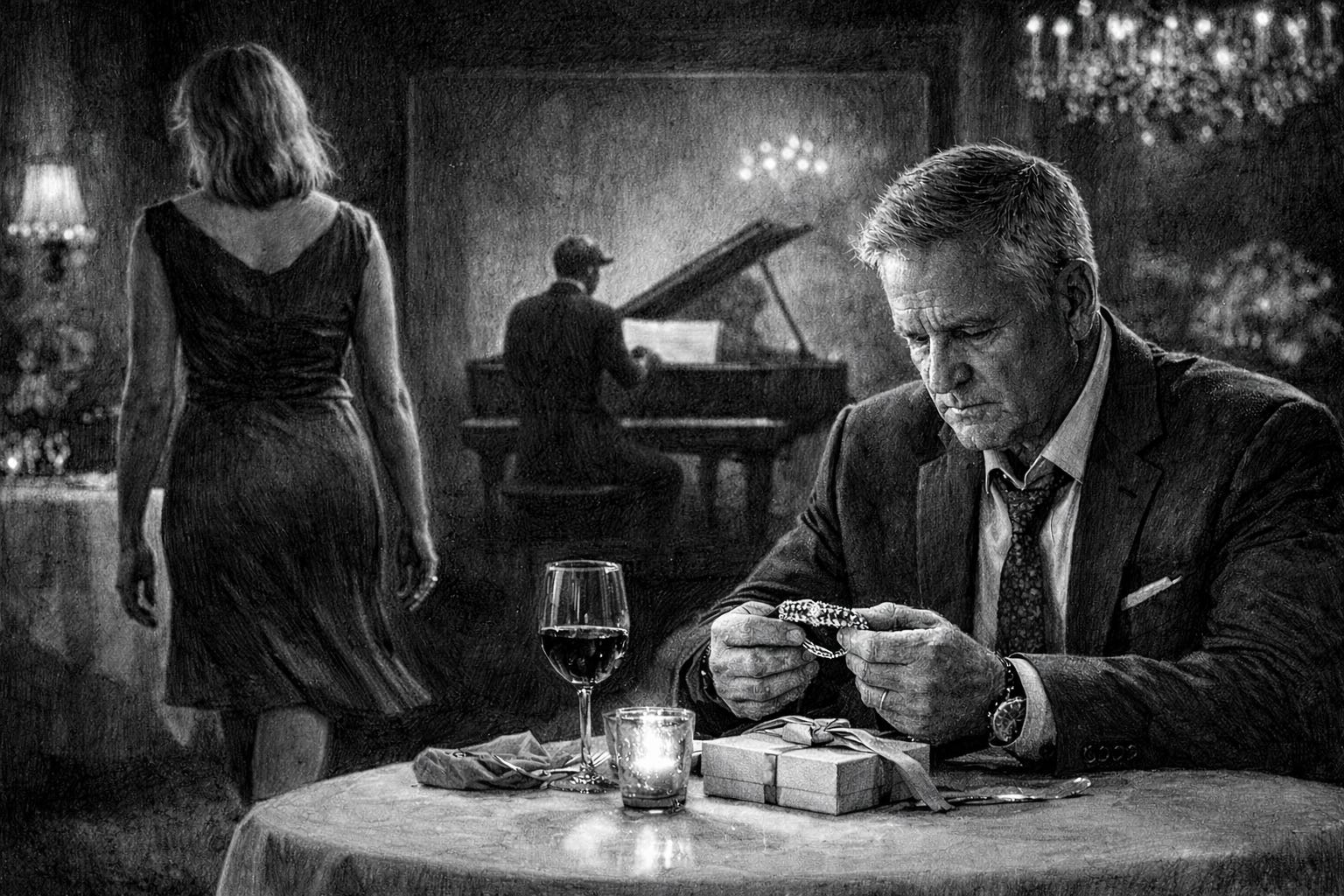
Kaycee and Landon’s table had been arranged deliberately in the far back corner of the restaurant, where the light dimmed just enough to soften the edges of faces and the noise thinned into something almost reverent. A pianist played Mozart on a Steinway, and back here, the sound had this quiet, angelic quality to it, as if they were in a cathedral. Angelo’s was a restaurant designed for Houston’s elite, a place where privacy had been refined and the menu written with the elegant grace of a nineteenth century scribe. Prices were absent, not necessary for patrons who counted their wealth in at least nine figures of dollars. The waiters moved with measured precision, white jackets immaculate, black ties perfectly centered, their expressions molded into a calm attentiveness that carefully served the guests with a grace they had been trained to perfect.
Around them sat the familiar figures of Houston success, men and women whose names appeared on buildings, on collegiate endowments, and on charities around the state of Texas and the world. Conversations unfolded in careful tones, a hum of grandeur known only to those who owned the world and made its rules. Wealth, Kaycee thought, forced a peculiar set of manners, manners that looked down on open braggadocio unless one were to require a building with their name on it in exchange for a donation. She’d always found that odd.
Kaycee and Landon were known here, maybe not as long as most of the others in the room, but long enough so that the staff knew today was their thirtieth wedding anniversary. Today marked the tenth consecutive year they had celebrated at Angelo’s and on the nine previous occasions, all felt right in Kaycee’s world. Wealth did have its perks after all. But on this night, something was off, something deep had troubled Kaycee for the entirety of the day.
Landon sat across from her, absorbed in his menu, his posture relaxed in a way that suggested familiarity with elegant rooms and staff attending to him as if he were a king. His features were pleasant, his jaw firm and his skin taught. The suit was Armani, dark and perfectly fitted, the kind of garment that did not draw attention to itself yet quietly announced its cost to anyone trained to notice. His hair was neatly arranged, threaded with gray he no longer attempted to disguise, and the faint scent of his cologne, sharp, expensive, deliberate, lingered between them. It was not the smell of the man she had married. That scent had been simpler and raw. Irish Spring soap, Old Spice after shave, and that ever-present scent of oil that clung to him from his days of working in the oil fields. She found herself lately missing that old smell, and the man that used to bear it.
She watched him without meaning to, and then longer than she should have, and that sickening feeling of disappointment crept through her stomach. It made her feel nauseous.
It was Landon’s discussion with Juan, their yard guy, that had troubled her. Up until this morning, she had not thought his success had changed him in any real way. There had been no midlife crisis, no girlfriends, nothing like that at all to her knowledge. He was still polite, still composed, still attentive in the manner of a man who understood expectations and met them consistently, at least on the surface. But as she sat there and looked at him, really looked at him, she began to realize just how different their relationship was today when compared to their early years. He had learned how to belong in this world he had built, how to move through it with ease. Even seated, even silent, he occupied the space with confidence. It occurred to her then, for the first time, that this world of wealth that had once embarrassed him he now embraced with the swagger of one born into it.
When he finally looked up, his expression softened into a smile that felt practiced but sincere enough to almost pass. His eyes met hers, and for a fleeting moment she saw something familiar there - an echo, perhaps, or a habit of affection that had survived its original purpose. But then it was gone as quickly as it came.
“I got you something,” he said. “Something I had Brad over at Overton Jewelers make special for you.”
The statement was harmless, loving even in most circumstances. It was the sort of thing a man says when he’s proud to bestow a gift to his wife that he had worked hard to obtain. But it was the look in his eyes when he handed her the perfectly wrapped package topped with a pretty green bow that undid her. They were the eyes of a man going through the motions, as if he was only there because it was required that he be there. It was the statement of someone who had learned that participation itself could substitute for presence if said in the practiced tone of sincerity.
As she took the gift from him, she noticed the perfectly scripted writing on the little card attached to the bow, the calligraphy was exquisite, done by a hand that was not her husband’s. I Love You Sweetheart – Landon. No doubt he told the girl at the store what to write, but he hadn’t taken the time to sign it himself. She bet he hadn’t even seen the gift that he had purchased for her.
She placed the little package on the table in front of her and lowered her eyes to the card, to the carefully chosen words and artful writing, and found that they refused to settle into meaning. The letters lay obedient on the page, graceful and certain, yet strangely hollow. They carried none of the weight of a hand that had trembled slightly while writing them, none of the imperfect pressure of ink pressed too hard against paper. Instead, they felt curated, as though affection itself had been outsourced.
Her mind, without asking permission, returned to the driveway that morning.
She had not meant to watch. She had been standing at the kitchen window with her coffee, absently observing the familiar rhythm of the yard being tended. Juan had worked their property for over thirty years. His company serviced the dozens of buildings Landon owned across the city. He had been there when the children were small, when their house was modest, when Landon’s boots were still dusted in oil-field grime. He had stood beside Landon at cookouts, had laughed with him about old football games and high school stories. There had been a time when they had spoken like brothers.
But this morning the air between them had not been brotherly.
She remembered Juan’s hat clutched in his hands, twisting slightly, his voice low and careful. She could not hear the words from inside, but she knew the posture. A request. A plea. And then she had seen something in Landon’s face she did not recognize, not anger or irritation, but calculation. A tightening of the jaw that signaled assessment. It was the face of a man determining risk and exposure.
Juan’s smile had faltered at first. It always did. He was a man who smiled through embarrassment, through apology, through pain. But this time the smile did not recover. It collapsed. His shoulders sagged not like a worker dismissed for poor performance, but like a friend who had misjudged the depth of a bond. When Landon turned and walked back toward the house without touching his shoulder or shaking his hand, Kaycee felt something tear inside of her. It was small and silent, but unmistakable.
Now, sitting in the romantic candlelight of Angelo’s, she understood that what unsettled her was not merely that Landon had fired Juan, it was how easily he had done it. A thirty-year relationship had been discarded like yesterday’s trash. Landon’s execution of the talk had been clean and clinical, as though firing a man who had been as close as family required no more emotion than the signing of a contract.
The waiter shifted nearby, attentive without intruding.
Across from her, Landon waited with the mild confidence of a man certain that generosity, once purchased, could settle any account. The gift remained unopened between them.
And in that narrow space, between presentation and gratitude, Kaycee felt a truth assembling itself inside her with terrible precision: that the man who once would have emptied his pockets for a friend, now weighed men the way he weighed investments.
The recognition did not arrive loudly. It settled like ash from a dying fire.
**
It had been early that morning when Juan knocked on the side kitchen door. Kaycee remembered the sound distinctly now, not the firm knock he used when announcing himself for work, but something softer, hesitant, as though he were uncertain whether he ought to knock at all. She had been standing at the counter, sunlight pooling across the marble, steam rising from her coffee. She had her iPad with her, scrolling through her daily feed of Christian video’s and was fully engrossed in a new Brandon Lake song when Juan knocked.
When she opened the door, Juan stood there holding his hat in both hands.
He had aged in the way men who work outdoors age. His naturally dark skin had been further darkened by the sun, lines etched deeply in his face like old leather from years of squinting into light and wind. But his eyes were still bright and earnest. He smiled when he saw her, though the smile trembled at the edges and did not reach his eyes.
“Kaycee,” he said softly
She knew immediately something was wrong.
“Juan,” she replied warmly. “Are you ok?”
“Yes, ma’am. I…” He hesitated, looking past her shoulder as if the polished kitchen was something sacred he did not wish to disturb. “I was hoping maybe I could speak with you a moment. If you have the time.”
There had been something in his voice that caused her to step aside without thinking.
“Of course,” she said. “Come in.”
He did not step fully inside. He stood just across the threshold, as if uncertain whether he belonged past it and she remembered thinking how much that bothered her.
She remembered noticing then how carefully he had dressed, his work shirt freshly pressed, boots cleaned as best they could be cleaned. A man preparing himself for something weighty.
“What’s wrong Juan?” she asked gently.
He took a breath.
“It’s about some of the boys who work for me,” he said. “I have several young men in my crews who are immigrants and some of them aren’t fully legal. The two boys who come with me to your house, they are cousins, but they don’t have their visas.”
She nodded. She had seen them on the property from time to time. They were quiet boys, quick to smile and always respectful.
“We’ve been working to fix their papers,” Juan continued. “I have about twenty men on my staff that are undocumented. I want to make everything fully legal. But the lawyer… it costs more than we thought. Much more.”
He swallowed, and she saw his fingers tighten around the brim of his hat.
“I was wondering,” he said slowly, “if maybe Landon would consider a loan, just until we can get it settled. I’d pay it back. Every dollar. He can take it directly from the money he pays us to service his properties.”
The shame in those words lingered on his lips. Not because of the request itself, but because of the necessity of asking for a loan.
Kaycee did not hesitate.
“Juan,” she said softly, almost surprised he would worry. “You and Landon grew up together. You’ve been with us since the beginning. Of course he’ll help you.”
Relief had flooded his face then, so quickly it startled her. It was as if he had been bracing for rejection and instead found mercy.
“You think so?” he asked. “The lawyer tells me this could end up costing close to two-hundred-thousand dollars.”
“I know so,” she said. And she had meant it. “You’re family.”
She thought of the early years, the cramped first house, the nights Landon came home with grease still under his fingernails, the two of them sitting at the kitchen table with bills spread out before them. She thought of Juan bringing over tamales at Christmas, of the way Landon used to clap him on the back and call him “brother.” She remembered how their kids played together and how often their families cooked out together.
Then she thought of the man she married, the one who would give the shirt off his back if it meant helping someone he loved.
“Talk to him,” she said. “He’ll be leaving for the office soon.”
Juan nodded, gratitude shining plainly across his face.
“Thank you, Kaycee,” he said awkwardly. “I didn’t know what else to do.”
She smiled at that.
“You came to the right place,” she said. “You’ve helped us plenty over the years.”
He stepped back outside then, lighter somehow, and she watched him cross the driveway toward the front of the house where Landon was finishing his coffee on the patio.
She had not meant to watch what followed. But she did.
**
Kaycee lifted the little gift box from the linen tablecloth, the gold paper catching the candlelight in small, obedient flashes. It was wrapped perfectly. Not a crease out of place. The bow rested at the center like something ceremonial. For a fleeting and unwelcome moment, she thought how fitting it was that something so hollow should appear so radiant.
Across from her, Landon watched with quiet expectancy.
Just as her fingers slipped beneath the ribbon, his phone chimed.
He did not hesitate. He withdrew it from his pocket and glanced at the screen, raising one finger toward her without looking up - a small, reflexive gesture requesting patience. He began typing immediately, his face illuminated by the pale blue light of the device. His brow tightened slightly, not in worry, but in concentration.
Kaycee lowered the box back to the table.
Mozart continued to drift through the room, angelic and detached, as if unaware that something far less beautiful had already occurred earlier that morning.
Her mind returned to the kitchen and to the sound of the door closing behind Juan, and then to the silence that followed.
Landon had entered the house without haste. He poured himself a cup of coffee as though he had merely concluded an ordinary conversation about fertilizer schedules or irrigation lines. He did not look toward the window. He did not look toward her.
He stirred the coffee slowly. She had stood there and waited, believing he would offer her some explanation of what had just happened outside. He offered nothing and just continued to stir his coffee.
“Are you going to tell me what just happened out there?” she had asked finally, her voice careful, almost neutral.
He looked up then, not startled, but faintly irritated, as though the question required unnecessary revisiting.
“Nothing,” he said. “I just told him his services were no longer required.”
There had been no drama in his tone. No anger. No visible strain. It was that calmness that had unsettled her most.
“You fired Juan?” she had asked.
“I did.” The spoon tapped lightly against the mug as he set it down.
“I can’t do business with an outfit that employs undocumented workers,” he said. “It’s a liability.”
The word hung between them like a verdict. Liability is the word he used to describe Juan, their friend of over thirty years. He said it as if Juan were a faulty investment, as if thirty years could be audited and dismissed.
“I told him he could speak with you,” she said quietly, still in disbelief. “I told him you would help him.”
He exhaled through his nose, not loudly, but with the restrained patience of a man correcting a misunderstanding.
“You shouldn’t have done that,” he said.
“Why not?”
“Because I can’t lend him two hundred thousand dollars to fix his immigration problem. That’s not how this works.”
She stepped closer to him then, searching his face for some trace of the boy she once knew, the one who had slept on borrowed couches and eaten off paper plates.
“He’s not asking for charity,” she said. “He’s asking for a loan. He said you could deduct it from his contracts.”
“That’s not the point.” His voice remained even, clinical.
“I have lenders, investors, board members. You think they’d be comfortable knowing I’m tied to a company knowingly employing illegals? It exposes us. It invites scrutiny. Once you make an exception, you establish precedent.”
He spoke as though explaining arithmetic.
“And helping a friend is now precedent?” she asked.
He looked at her then, and something in his gaze shifted, not anger exactly, but fatigue, like he’d been put out.
“This isn’t about friendship,” he said. “This is about scale. We don’t live in a two-bedroom house anymore. We have responsibilities.”
“Responsibilities to who?” she asked.
“To everyone who depends on me,” he replied.
She felt something tighten inside her chest.
“And Juan doesn’t depend on you?”
He shook his head slowly.
“He runs a business, Kaycee. He chose to hire who he hired. That’s his decision. I’m not obligated to underwrite it.”
She stared at him, knowing there was more he wasn’t saying.
“You grew up together.”
“Yes.”
“He stood beside you when no one else did.”
“Yes.”
“And doesn’t that mean something?” she pressed.
“It did,” Landon said. “At one time.”
The past tense landed heavily.
“But it doesn’t mean I should jeopardize everything I’ve built.”
She could not remember when he began speaking in such language - built, jeopardize, exposure, risk. Words that belonged in boardrooms, not kitchens.
“Do you remember,” she said slowly, “when your truck broke down in ‘98? And you were about to lose that job because you couldn’t get to Odessa? Do you remember who loaned you the money?”
He did not answer immediately and that told her he remembered exactly what she was talking about.
“Juan gave you his last nickel,” she said. “He had two babies at home, and he still handed you that envelope. He didn’t talk about liability. He didn’t talk about precedent.”
A flash passed through Landon’s eyes then, not guilt, but irritation. But he didn’t respond.
“Who was it that bailed you out of jail all those years ago for that DUI you got?” she asked. “Remember that? He was always there for you.”
“I’ve repaid him a thousand times over,” he said. “You think he didn’t benefit from our relationship? Every property I own runs through his company. He’s made a fortune because of me.”
The words were sharp now. He didn’t shout or even raise his voice in any noticeable way. But the words and tone were like a razor.
She felt as though she had been struck.
“He’s a yard guy,” Landon continued, the phrase emerging like he was talking about a pair of dirty shoes. It was the clarity that chilled her. “This is business. Nothing more”
There it was. The line that separated what once had been from what now was. This is business.
In that moment she realized something far more unsettling than anger. Landon did not see Juan as anything more than a contractor, just a dirty yard guy, and dirty lawn guys were a dime a dozen. He could replace him with a thirty-second phone call and their past relationship meant absolutely nothing.
He had not dismissed Juan in rage, he had dismissed him after doing a cold, calculated analysis and that is what bothered her the most.
“Your investors and lenders could care less about whether he had illegals working for him,” Kaycee said. “And even if they did, you could have told them he was working on fixing that. You could have stood up for him, and they would have supported you.”
Landon didn’t answer her right away. He calmly sipped his coffee.
“He would have expected more eventually,” Landon added. “And once you open that door, it never closes. Every contractor, every employee, every friend from high school with a sob story would come knocking. You have to draw lines.”
She thought of Juan standing at the threshold that morning, not stepping fully into the kitchen. Perhaps he had known already that there were lines he could not cross.
“You drew that line through him,” she said softly. “A man who has been with you over a lifetime and who loves you.”
Landon picked up his coffee and took another measured sip.
“This is how you protect what you’ve built,” he said. “Sometimes you have to make tough decisions.
Protect what you’ve built. Not what you’ve shared. Not what you’ve been given. Not what you’ve been blessed with. Only what you’ve built. As if all of it had been self-forged.
She studied his face then, really studied it - the clean shave, the pressed shirt, the calm eyes that revealed no tremor. He looked composed and certain, a man at ease with his reasoning without a regret in the world
And that certainty frightened her more than if he had shouted, because it meant this was not a momentary lapse or a bad morning. It wasn’t stress talking. It was a transformation.
“You didn’t even shake his hand,” she said.
He looked at her, puzzled.
“What?”
“When he left,” she said. “You didn’t even shake his hand.”
Landon’s jaw tightened slightly.
“Would that have made you feel better?” he asked, with a chuckle that had no humor in it at all.
She felt something fracture quietly inside her, not explosively, but with the soft inevitability of something long under strain. He had once been a man who would not have hesitated to write a check to Juan and he’d have walked through the fires of hell to defend him.
But this man – this man could have cared less about such things.
**
Mozart did not falter.
The notes continued their measured ascent and descent as if heaven itself required no interruption for human fracture. The pianist’s hands moved with disciplined grace. The waiters glided between tables bearing wine and crystal and delicacies arranged like offerings. No one in Angelo’s noticed the small tremor that had already begun to run beneath one particular table in the back corner.
Landon’s phone finally went dark. He set it down beside his plate, exhaled once, and offered her the faintest apologetic smile. “Sorry,” he said. “That was Dallas. We’re closing on the Richardson property tomorrow.”
He said it the way he once might have said, I fixed the truck, or I got the job. As if the accomplishment itself were proof of virtue.
“It’s fine,” Kaycee replied. Her voice surprised her. It was steady.
He nodded toward the gift. “Go ahead,” he said. “Open it.”
The gold paper caught the candlelight as she lifted the box once more. The wrapping was flawless, corners folded with mathematical precision, the ribbon tied in a bow so symmetrical it might have been diagrammed. It looked ceremonial, almost sacred.
She untied the ribbon. The lid lifted without resistance. Inside, resting in a cradle of white satin, lay a bracelet so radiant it looked almost alive. Diamonds, cut to ruthless perfection, circled the band in uninterrupted brilliance. At its center, set like a crown jewel, emeralds glowed a deep and velvety green, an ancient green of something mined from the earth at great cost.
The diamonds caught the candlelight and fractured it into a thousand shards.
For a moment, the light danced across her face.
Landon leaned forward slightly. “It’s Colombian emerald,” he said, pride softening his voice. “Brad said it’s one of the cleanest stones he’s ever seen. The whole piece is custom. There’s nothing else like it in the world.”
She did not doubt him. It looked like it cost at least a hundred thousand dollars. It looked like something placed on the wrist of a woman who had never known fear, who had never watched a man twist his hat in his hands at her kitchen threshold, who had never measured the distance between who her husband had been and who he had become.
“It’s beautiful,” she said.
And it was.
She lifted it carefully. The weight of it surprised her. It was heavier than it appeared, as if the earth from which it had been pulled had not yet relinquished its claim. She held it against her wrist but did not fasten it.
Landon watched her, searching her face for approval, for delight, for the reaction he had paid for.
The emeralds shimmered and, unbidden, another green surfaced in her mind.
A patch of grass behind their first house - not grass, really, but stubborn weeds and dirt that Juan had helped Landon level one summer afternoon while the children ran barefoot through the sprinkler. The house had been small then. The air conditioner rattled. The roof leaked in two places. They had eaten off mismatched plates and counted coins before grocery runs.
Juan had come over with his wife, Marisol, carrying foil trays of carne asada and rice. Marisol’s laughter had filled the cramped kitchen. The men had stood near the grill, sweating in cheap cotton T-shirts, arguing about the Oilers, about high school games, about who had been faster in their senior year.
Landon had laughed differently then. There was no restraint in his laugh, no calculation. He had laughed from somewhere unguarded, the same place where his words came, natural and true.
That night, long after the grill cooled, the four of them had sat in folding chairs under a sky so thick with humidity it felt close enough to touch. The children had fallen asleep on blankets inside. Juan had told a story about getting lost near Laredo as a teenager, and Landon had slapped his knee and said, “Brother, if you ever get lost again, you come find me.”
Come find me.
She could still hear it.
She looked down at the emerald again. Its green was deeper, colder somehow. A green polished by a jeweler, not by life.
“I remember when we couldn’t afford a babysitter,” she said softly.
Landon blinked. “What?”
She smiled faintly, not at him but through him.
“We used to take the kids to Juan’s on Friday nights. Remember? Marisol would watch them so we could go get tacos on Highway 59. That little place with the broken neon sign. We went there for our second anniversary, remember that?”
He chuckled lightly. “God, that place. We thought that was fine dining.”
“It was,” she said.
It had been. Because back then, she had all of him. Money didn’t matter, his portfolio didn’t matter, acquisitions didn’t matter. It was just him – all of him.
She slipped the bracelet around her wrist and fastened it. The diamonds ignited beneath the candlelight. For a brief second, she saw how others would see it, the elegance, the wealth, the triumph.
Then she looked across at the man who had given it to her. Something had broken inside of her at that instant. It amazed her how the character of a single moment could change so completely that it revealed a truth about the man she thought she knew.
His suit fit perfectly. His hair was immaculate. His posture spoke of authority, of control. He belonged here now in a way he once had not. He moved through rooms like this without self-consciousness, without the old hint of embarrassment she used to find endearing.
He had learned the language of this world, and somewhere along the way, he had forgotten another one.
“You did good,” he said quietly, mistaking her silence for awe. “We did good.”
We.
She studied him. There was no cruelty in his expression. No malice. Only certainty. The calm of a man who believed himself righteous in his prudence.
Her mind moved through the years not in chronology but in weight.
The first years: scraping by. Sharing everything. Fear and hope braided together so tightly they could not be separated.
Then the middle years: expansion. Success. Late nights. Bigger house. Juan’s company growing alongside Landon’s portfolio. Cookouts growing less frequent, then rare.
Then the recent years: invitations to places like Angelo’s. Galas. Fundraisers. Speeches about moral foundations and civic duty. Carefully worded philanthropy. Strategic generosity.
Somewhere in there, she had felt the shift.
I had all of you, she thought. Back when there were no lines to draw because there was nothing to protect but each other. Then most of you. When ambition began to outpace simplicity but love still filled the gaps. Then some. When meetings and mergers and metrics began replacing late-night talks at the kitchen table.
And now - None.
The realization did not come as rage. It came as grief. She removed the bracelet slowly.
Landon frowned faintly. “What are you doing?”
She laid it carefully on the table between them. The diamonds continued to sparkle, indifferent. He stared at her, confusion forming.
Then she stood and she walked to him and she bent gently and kissed him on his cheek.
“I’ve always loved you,” she said softly. And with that, she turned and walked out of the restaurant.
Behind her, through glass and candlelight and emerald glow, a man sat alone at a table in the back corner of Angelo’s, staring at a bracelet that cost a fortune, waiting for some kind of feeling to arrive.
I enjoyed this story so much. It is so moving.
Thanks so much for the feedback Tom - I 100% agree with you!